









|

| | Roman Imperial Coins
The coins listed on the sub-pages will be
attributed to the number in each of the ten volumes of the series "Roman
Imperial Coins", published by Spink & Son LTD, London.
Denominations
Ancient coinage during the Imperial period of the Roman
Empire can be very confusing, as there are some general rules, but there are
always pieces that turn up to be exceptions. Here is a basic chart,
showing denominations as they progressed from the beginning of the Imperial
period up to the beginning of the Byzantine period. AV = Gold, AR =
Silver, AE = Copper, Bronze or Orichalcum (Brass)
|
Denomination
Name, Value, Composition and Size |
|
Imperial
Coinage Begins - 14 AD
|
| |
AV
Binio (or Double-Aureus) = Gold Medallion |
 |
AV
Aureus = 25 Denarii (Gold, 20mm) |
| |
AV
Light Aureus (Gold) |
 |
AV
Quinarius =12-1/2 Denarii (Gold, 15mm) |
 |
AR
Denarius =16 Asses (Silver, 19mm) |
 |
AR
Quinarius = 8 Asses (Silver, 15mm) |
| |
AE Double-Sestertius = 8 Asses (Brass or
Orichalcum, 24-35mm) |
 |
AE
Sestertius = 4 Asses (Brass or Orichalcum, 25-35mm) |
 |
AE
Dupondius = 2 Asses (Brass or Orichalcum, 28mm)
|
 |
AE
As = Base Unit (Copper, 24-28mm) |
 |
AE
Semis = 1/2 As (Brass or Orichalcum, 18mm) |
 |
AE
Quadrans = 1/4 As (Copper, 15mm) |
 |
AE
Uncia = 1/12 As
|
|
Denomination
addition by Caracalla, 215
|
 |
AR
Antoninianus = 2 Denarii (Initially silver, very base billon at time of
Demonetization) |
|
Coinage
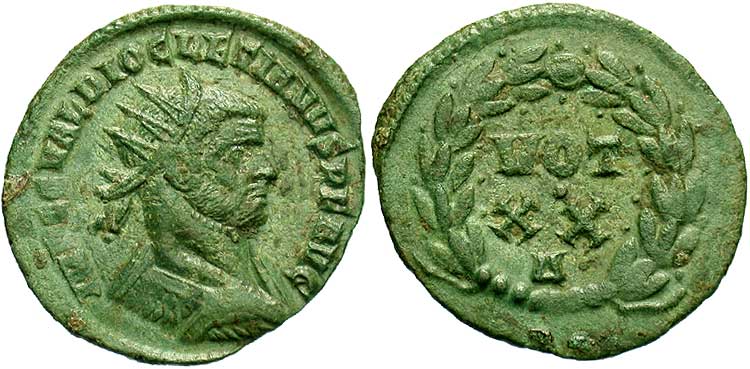
reforms by Diocletian, c. 294
|
| |
AV
Aureus = 120 Folles (Gold) |
| |
AV
Quinarius = 60 Folles (Gold) |
| |
AV Quarter-Aureus = 30 Folles (Gold) |
 |
AR
Argenteus = 5 Folles (Silver) |
 |
AR Half-Argenteus = 2-1/2 Folles (Silver) |
 |
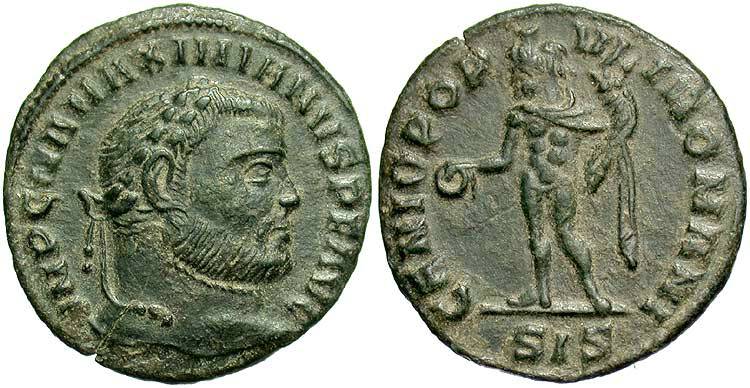
AE
Follis = Base Unit (5% Silver) |
 |
AE Half-Follis = 1/2 Follis (Billon?) |
 |
AE
Post-Reform Radiate = 2/5 Follis (Bronze) |
 |
AE Third-Follis = 1/3 Follis (Billon?) |
 |
AE Quarter-Follis = 1/4 Follis (Billon?) |
| |
AE
Post-Reform Laureate = 1/5 Follis (Bronze) |
|
Coinage
reforms by Constantine I, c. 318
|
| |
AV
Solidus = 24 Siliquae (Gold) = 72 to the Roman Pound |
| |
AV
Semissis = 12 Siliquae (Gold) |
| |
AV
1.5 Scripulum = 9 Siliquae (Gold) |
| |
AR
3 Miliarense = 4 Siliquae (Silver) |
| |
AR
Heavy Miliarense = 5.4g Silver |
| |
AR
Miliarense = 1-1/3 Siliquae (Silver) |
| |
AR
Heavy Siliqua = 1-1/5 Siliqua |
| |
AR
Siliqua = Base Unit (Silver) |
| |
AR
Post-Reform Light Siliqua = 144 to the Roman Pound |
| |
AR
Heavy Half-Siliqua = 3/4 Siliqua |
| |
AR
Post-Reform Light Half-Siliqua = 288 to the Roman Pound |
 |
AR Third-Siliqua = 1/3 Siliqua |
 |
AE1
(Bronze, >25mm) |
 |
AE2
(Bronze, 21-25mm) |
 |
AE3
(Bronze, 17-22mm) |
 |
AE4
(Bronze, <17mm) |
|
Coinage
during reign of Constantine's successors, c. 337 and later
|
| |
AV 9 Solidi (40.32g, 8/lb.) = 216 Siliquae |
| |
AV 4-1/2 Solidi (20.16g, 16/lb.) = 108 Siliquae |
| |
AV 3 Solidi (13.44g, 24/lb.) = 72 Siliquae |
| |
AV 2 Solidi (8.96g, 36/lb.) = 48 Siliquae |
| |
AV 1-1/2 Solidi (6.72g, 48/lb.) = 36 Siliquae |
| |
AV 1-1/4 Solidi or AV Festaureus (5.39g,
57-60/lb.) = 28.8-30 Siliquae |
 |
AV Solidus (4.48g, 72/lb.) = 24 Siliquae |
| |
AV Semissis (2.24g, 144/lb.) = 12 Siliquae |
| |
AV 9 Siliquae (1.67g, 192/lb.) = 9 Siliquae |
| |
AR 4-Siliqua (13.44g, 24/lb.) = Value of 72
Siliquae |
| |
AR Heavy Miliarensis (5.37g, 60/lb) = Value of
28.8 Siliquae |
 |
AR Light Miliarensis (4.48g, 72/lb) = Value of 24
Siliquae |
 |
AR Siliqua (3.36g, 96/lb) = Value of 18 Siliquae |
| |
AR Reduced Siliqua (2.24g, 144/lb) = Value of 12
Siliquae |
 |
AE
Maiorina or Double Centenionalis = AE1 (Bronze, 27mm) |
 |
AE Centenionalis = 100 old Denarii (Bronze, 23mm until 354, then
18mm - FEL TEMP REPARATIO series |
| |
AE
Centenionalis = 100 old Denarii (Bronze, 15mm after 354 - SPES
REIPVBLICAE series |
 |
AE Half-Centenionalis = 50 old denarii (1% Silver) |
|
Coinage
addition by Theodosius, 383
|
 |
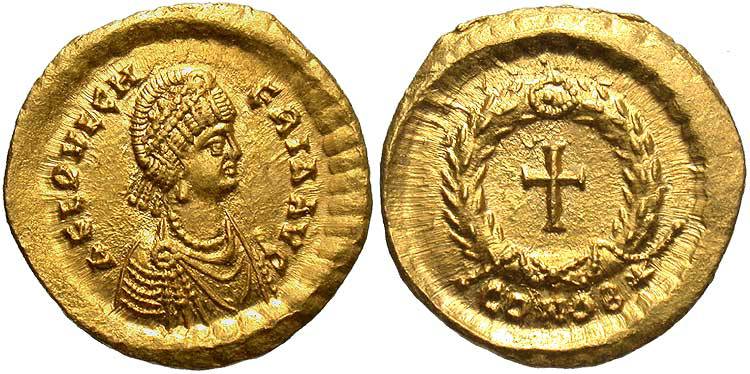
AV
Tremissis = 1/3 Solidus (Gold) |
|
These are the denominations issued by Imperial
mints. There were, however, literally hundreds of Provincial mints
operating at the same time all throughout the Empire. The Provincial mints
created coinage that was mainly used in their area and often have Greek
legends. They are extremely varied and interesting since the mints were
able to use pretty much whatever reverse designs they wanted. Below are
some other unusual coins which can be encountered, but don't fit the usual
designations on the chart...
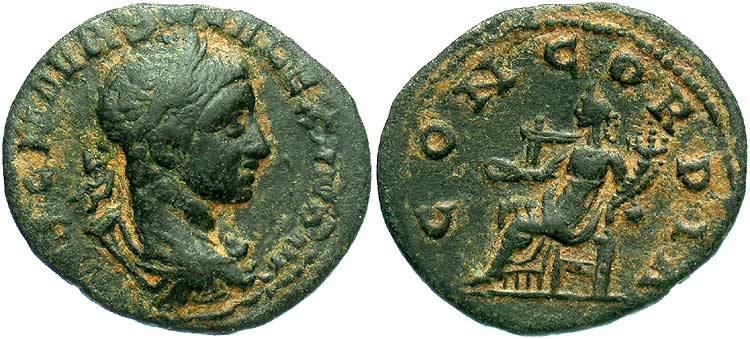
AE Denarius
- Unofficial? (Bronze, 19mm)

Severus Alexander, AE (Limes) Denarius, 222-235
IMP C M AVR SEV ALEXAND AVG
Laureate, draped bust, right
CONCORDIA
Concordia seated left, holding patera and cornucopiae
Style of Antioch mint
RIC IV, Part II, 275 for type

Severus Alexander, AE (Limes) Denarius.
IMP ALEXAN_DERIVS AVG Laureate, draped, cuirassed bust right.
PVDICITIA Pudicitia seated left, holding scepter in left hand, right hand
drawing veil. Similiar to the base denarius hybrid RIC IV, Part II, 307 in
the British Museum, but different obverse legend.
These enigmatic little pieces belong to a
group of coins referred to as limes denarii, limes falsa or AE denarii.
There are numerous theories as to their purpose. Some believe they were
minted in the outskirts of the Roman Empire to circulate there. Some
contend they are non-Roman imitative (barbarous) types. One theory I have
is they were made for the soldiers defending the outer regions of the empire,
paid to them in lieu of silver, in the event the territory was lost. This
would not have not enriched an enemy victor of a lost region with silver or
gold. With my theory, these AE pieces could, if a soldier returned to a
main part of the empire in retirement or if an area was forfeited, could in turn
be redeemed for equivalent AR denarii, just as US soldiers used scrip during
foreign wars. We will probably never know their purpose, but they can be
found in excellent condition and are very collectable.
Another unusual aspect of this piece is the
obverse legend. No such legend was used on official Roman coins, but it
has been proposed this piece may have meant to read IMP ALEXAN_DER PIVS AVG, but
the P is missing in PIVS.
Trajan, Orichalcum Radiate As, 115-116, Rome.
IMP CAES NER TRAIANO OPTIMO AVG GERM Radiate bust right, drapery over left
shoulder. DAC PARTHICO P M TR POT XX COS VI P P | S C Oak wreath.
23mm. RIC II, 648.
Note on Antoniniani:
The antoninianus began as part of a monetary reform of Caracalla in 215.
Designed to be tariffed at two denarii, it was of good silver, but physically
weighed less than two silver denarii. This was one factor in the rise of
inflation and the decline of the economy in general. As the decades continued, the
antoninianus declined from good silver all the way down to a low point of 1 part
silver to 20 parts bronze. This debasement was noted in the exergue of the
later issues as XXI. Another popular theory for the exergual mark XXI is
the coin was tariffed at a rate of 20:1. The monetary reform of Diocletian
around 294 brought about the demise of this physically attractive denomination and
replaced it with an even larger module, called a follis by modern
numismatists. Actually, the name "antoninianus" is of modern
origin as well, since we really do not know what the ancient Romans called them.
|