|
|
Numismatic Evidence of the Jewish
Origins of the Cross Collection T. B. Cartwright Introduction Anticipation for the Jewish Messiah’s first prophesied arrival was great and widespread. Both Jewish and Samaritan populations throughout the known world were watching because of the timeframe given in Daniel 9. These verses, simply stated, proclaim that the Messiah’s ministry would begin about 483 years from the decree to rebuild Jerusalem in 445BC. So, beginning about 150 BC, temple scribes began placing the Hebrew tav in the margins of scrolls to indicate those verses related to the “Messiah” or to the “Last Days.” The meaning of the letter tav is “sign,” “symbol,” “promise,” or “covenant.” Shortly after 150 BC, the tav (both + and X forms) began showing up on coins throughout the Diaspora -- ending with a flurry of the use of the symbol at the time of the Messiah’s birth.
The Samaritans, in an effort to remain independent of the Jewish
community, utilized a different symbol for the anticipation of their Messiah or
Tahib. Their choice was the
tau-rho monogram,
As a result, the symbols ( +, X
and
The Cross and the
Messiah – the Vatican’s View The lack of credible evidence of
the true history of the cross was probably the biggest disappointment during the
research for this paper. The
“official history” of the cross comes from the Vatican -- which notoriously
rewrote history to validate Catholicism.
(A prominent example of a misleading claim is that Peter was the
first Pope when, in reality, Yakov (James), Yeshua’s brother, was the first
Bishop of the Jerusalem church.)
But where the history of the cross is concerned, the Vatican’s version
says that the cross originated in the year 200 AD in the catacombs of Rome (as a
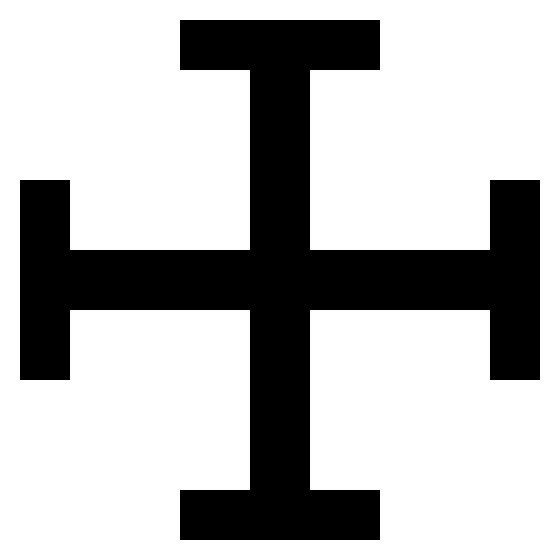
Greek cross in Figure 1). The
reason given for such a late origination of the cross comes from the early
Church fathers who said that the cross stood for Christ’s suffering and the
overwhelming shame of that made it too unbearable to use as a symbol.
As a result, the first “official” cross, known as the Latin cross, was not designated until the time of Constantine the Great,
after the Council of Nicaea. An
example of the first use of the
Latin cross can be seen on a bronze
follis from 334 AD in Figure 2.
Here is a good summary of the Catholic Church’s version of the history of the cross from Marucchi’s work in 1908: “…the cross should have appeared in Christian homes as an object of
religious veneration, although no such monument of the earliest Christian art
has been preserved.” “The cross, therefore, appears at an early date as an element of the
liturgical life of the faithful, and to such an extent that in the first half of
the third century Tertullian could publicly designate the Christian body as
"crucis religiosi", i.e. devotees of the Cross.” “It is probable, though we have no historical evidence for it, that
the primitive Christians used the cross to distinguish one another from the
pagans in ordinary social intercourse… and …replied to the pagan taunt by
showing that their persecutors themselves adored cruciform objects.” “The second event was of even greater importance. In the year 326 the
mother of Constantine, Helena, then about 80 years old, having journeyed to
Jerusalem… would discover the Saviour's Tomb and His Cross…” Marucchi, O. (1908).
Archæology of the Cross and Crucifix. In The Catholic Encyclopedia. New York:
Robert Appleton Company. Retrieved
November 12, 2011 from New Advent: http://www.newadvent.org/cathen/04517a.htm It is important to point out that Helena had several historians and writers in her contingent to Jerusalem. Their purpose was to detail her activities and the journals of the trip still exist. However, none of their extensive, detailed writings mention “the greatest archeological find of all time” – the cross on which Christ was crucified. So, it is my speculation that the Latin Cross was contrived from a political arrangement between the Constantine government and the Roman Church’s desire to be unique as God’s chosen Church. Unfortunately, it is the “legend” of Helena’s cross that became the design basis for the “Christian Crosses” even into current times.
The Cross and the
Messiah -- The Facts
To quote John Adams, “…facts are stubborn things…” The historical and archeological evidence show clearly that the cross existed at least 350 years before the Vatican’s claim. Ancient coins provide the clearest, most convincing evidence that the simple cross was used not only by the early Christians just after the crucifixion but also by faithful Jews before Christ’s coming. Verifying evidence of the early cross can also be found in scrolls, ossuaries, and rings and coins in the centuries before and after Yeshua’s birth and death. (A complete chronology of Christian symbols can be seen in Appendix I.) Was this evidence known by early Christian fathers? Yes, it appears that theologians and historians have worked diligently through the centuries to suppress the knowledge of early crosses. Most examples were explained away as “ornaments,” “wheel spokes,” “four winds of the earth,” “stars ” or “ alignment marks.” The basis for this activity appears to be an anti-Semitic attitude and the desire to promote their own “orthodoxy.” The political pressure to keep the “history” secret was tremendous, as described by archeologist Charles Ganneau in 1873 upon discovering ancient crosses (Figure 3) on tombs and ossuaries dated to about 15 AD: “I do not think it can be anything other than the sign of the cross, but I do not overlook the difficulties which beset that view, considering our…ideas …to the earliest period at which the cross was recognized as the emblem of Christianity… If this cross is really a Christian symbol, we must … admit that the chronological rules upon which all archeologists have hitherto justly agreed with regard to Christian monuments do not apply…” Archaeological Researches in Palestine During the Years 1873 - 1874, by Charles Clermont-Ganneau, p. 403-4.
Additional archeological evidence includes the headstone of a tomb (Figure 4) that has a simple cross cut into the stone. This was reported in the Jerusalem Christian Review, Volume 9, Internet Edition, Issue 2. This find was located at the entrance of the “Mt of Olives” tomb discovered in 1953. It was also reported that several of the ossuaries in the tomb had sketches of crosses on them and that the tomb was used by Christians until 70 AD. So, what is the earliest known use of the cross as a symbol of the Messiah? The evidence trail begins with a recent archeological find -- the “Dead Sea Scrolls.” One of the most spectacular finds of the Dead Sea Scrolls was an intact version of Isaiah dated 150 BC. The document was believed to be transcribed by the Essenes from a version written in 350 BC. An interesting feature of the document is a series of scribal marks in the margins. The marks included dots, dashes, “hats”, and most importantly, crosses. The crosses were actually the Hebrew letter “Tav” which appears to indicate verses related to the End Times and Messiah. There are about 10 instances of the Tav used in this fashion. The literal translation of “Tav” is covenant or symbol. So, the logical conclusion is that these scribal marks are the earliest known correlation between the “Cross” and the “Messiah.” Example of these marks can be seen below in Figure 5 followed by the interpretation from Fred P. Miller:
The
verses (54:16 – 17) discuss the End Times and the protection God gives to
Israel. And
verses (55:3-5) discuss the Messiah “(3.) Extend your ear, and come to me:
hear, and your soul shall live; and I will make with you an everlasting
covenant, the faithful mercies of David. (4.) Behold, I have given him for a
witness to the people, a leader and commander to the people. (5.) Behold, a
nation that you do not know you shall call, and a nation that you have not known
shall run to you because of YHWH your God, and the Holy One of Israel;
for he has glorified you.” The Hebrew tav took many shapes and forms as seen in Figure 6. This is discussed in texts such as “The Ancient Hebrew Alphabet,” by Seekins, and “Treasury of Jewish Coins” by Meshorer. The most common examples were:
Earliest
Numismatic Uses of the Cross From the Diaspora It was after 150 BC that the “cross” began showing up on coins. First, they appeared on coins in the Diaspora, then on coins of the Hasmonean and Herodian dynasties. Geographical locations of “cross” in the Diaspora are shown on the map in Appendix II. Several examples of these coins are shown in Figure 7 below:
The coins above are presented only to show the symbol and the diversity of the locations. What could possibly motivate or coordinate such different nations – a world apart -- to use the same “+” symbol? It was a major challenge to find a common thread between such independent nations with disparate peoples. The only common characteristic found was the migration of the Jewish people to these areas in the preceding centuries – this dispersion is known as the Diaspora. One coin (Figure 8), however,
deserves more explanation. It
is a potin (lead alloy) coin from Celtic Gaul dated to about 30 BC. It shows a crescent and star at top, a “wavy” line
that dissects the coin with one cross above the wavy line and two crosses below
the wavy line. There is a straight
line toward the bottom held up by hatched lines.
The best information about the meaning of these symbols resulted in my
interpretation seen below the image.
First, the crescent moon and star represents the “Star out of Jacob” from Numbers 24. Next, Meshorer for example, suggests that wavy lines are
the curtain separating the Holy of Holies (or Heaven from earth).
Third, The Testament of Judah and Damascus Document both make numerous
references to “Two Messiahs” --
a concept
considered prophetical prior to the Maccabean rebellion.
Here are excerpts: “ ... during the time of ungodliness until the appearance of the
Messiahs of Aaron and Israel ” [Damascus document 12.23-13.1] “This
is the exact statement of the ordinances in which they walk until the Messiah of
Aaron and Israel appears and expiates their iniquity.”
[Damascus document 14.18-19] “Those
who heed Him are the poor of the flock; they will be saved at the time of
visitation. But others will be delivered up to the sword at the coming of the
Messiah of Aaron and Israel.” [Damascus document 19.9-11] “My children, be obedient to Levi and to Judah. Do not exalt yourselves about these two tribes because from them will arise the Savior from God. For the Lord will raise up from Levi someone as a high-priest and from Judah someone as king. He will save all the gentiles and the tribe of Israel.” [Testament of Simeon 7.1-2] So, the design of this coin clearly anticipates the coming Messiahs and connects them to the symbol of the cross as well as the relationship between the Messiah and God and their relationship between Heaven and earth.
Maccabean/Hasmonean Beginning about 167 BC, a Judean rebel group lead by Mattathias the Hasomonean and his son, Judah Maccabee, defeated the Seleucids and cleansed the temple. The victorious Maccabees in 163BC returned a sovereign nation back to Jewish people that hadn’t existed for centuries. This ultimately resulted in rulers that took both titles: “King” and “High Priest.” This rejected the theology of two Messiahs and plainly shows that one person could fulfill both roles. Each Hasmonean ruler proudly displayed the dual titles on their coins. A few coins actually displayed the “tav” as seen in Figure 9 below. John Hyrcanus, in about 135 BC, was the first to use the duel titles and was subsequently followed by Aristobalus, Janneaus, Salome, Hyrcanus II, Aristobalus II, and ended with Mattathias Antigonus in 37 BC.
The coins and situation concerning Mattathias Antigonus deserves extra attention. It is very interesting that two “tavs” appear in his name are arranged on his coins so that both variations of the tav are shown - the (+) and (x). In this fashion, the “priesthood” and “kingdom,” traits found in Numbers 24:17, are shown on his coins. The following images show an 8-prutot coin from Mattathias:
Mattathias was defeated in 37BC by Herod thus
ending the Hasmoneon Dynasty. eliminated
the whole concept of a “2-messiah” package and squarely posited the
possibility of a one-person Messiah fulfilling both roles as King and High
priest. This manifested
itself 30 years later with the Temple encounters of Simeon and Anna (Luke
2:25-38) who proclaimed Yeshua (Jesus) as
“Your salvation” and “the redemption of Jerusalem.”
Herod the Great Herod was a usurper to the throne. He was motivated by power and money and the result of his reign was the betrayal of the sovereign Jews. Herod had no allegiance to Jewish worship or tradition. One of his first acts as king after defeating Mattathias was to insert political hacks into the High Priest position which ended the Zadokite lineage. Herod seized on the opportunity to make the sacrificial system and money changing operation a profit center for his administration. Herod began a complete restoration of the Temple itself about 18 BC but was completed decades later. It was into this corrupt temple operation that Yeshua (Jesus) was born. Surprisingly, coins of Herod convey the anticipation of the Messiah within the remnant of dedicated Jewish religious beleivers. The main mint in Jerusalem produced small denomination bronzes that were crudely made. The design of these coins was relatively simple as nearly all reflected temple life in some fashion. However, there are two of the designs clearly show the anticipation and commemoration of the arrival of the Messiah. One prutah is designed with a diadem on the obverse and a sacrificial table on the reverse. This design exists both with and without the cross (tav) within the diadem. This has to indicate the anticipation (no tav) and arrival (with tav) of the Messiah. What or who else could possibly be so royal or divine that coins are designed specifically for their presence? The other prutah design shows crossed lulavs (palm branches) and the sacrificial table. The designs are shown with both un-opened and opened lulavs -- indicating the absence or presence of the Messiah. A couple of variations of the diadem/table design are shown in Figure 11:
The most likely dates for the diadem coins without the tav are 18 BC to 10 BC while the date for the “Messiah has arrived” coins is 6 BC based on the work by Dr. Molnar in his book on the Star of Bethlehem. A corresponding coin design, displaying the palm fronds, was minted in Jerusalem in the same time period as the diadem coins. Open palm fronds represent victory while un-opened palm fronds indicate the anticipation of victory. Notice also that the palms are arranged in the shape of the cross.
In the century after Herod’s death, numerous political and religious leaders influenced policy and laws. The Roman’s began the use of Prefects for governing Judaea, the Jewish religious leaders continued temple worship until 70 AD, and Christianity was growing through the known world. Persecution of the Christians began with the Jewish hierarchy soon after the Messiah’s death and resurrection. In 49 AD, Emperor Claudius issued an edict which protected the Christians from Jewish persecution. Roman persecution of the Christians began in earnest in 64 AD when Nero blamed them for the fire in Rome. The Jewish uprisings in 66 AD and 132 AD resulted in the near annihilation of the Jewish race. Roman persecution of the Messianic Jews (the Christians) ramped up during the reign of Trajan and Hadrian leaving only pockets of Christians throughout the Roman Empire. But before these groups were wiped out or dispersed, the use of particular symbols, especially the cross, continued.
First Century AD Christians For the first hundred years after Christ’s life, the vast majority of new Christians were Jewish. Numismatic evidence strongly suggests that this group of Messianic Jews kept the upright version of the tav (+) as the sign of the promised Messiah. The various locations of the coins displaying the “+” align neatly with the Jewish and Samaritan Diaspora.
First Century AD Jews While most of the new Christians were Jews, there remained a large Jewish population who rejected the divinity of Yeshua (Jesus) and continued with temple worship. It follows that they continued to look for their Messiah. Nearly all the coins of the prefects use the “x” tav outside a wreath to indicate that the Messiah has yet to arrive. Examples of this use of the tav is shown in the following figure. This continued until the destruction of the Temple in 70 AD.
Bar Kochba Coin Jerusalem was destroyed by Titus in 70 AD and the temple period ended. Persecution of Christians was now widespread by the Romans and little or no evidence of religious symbols are seen in any ossuaries, jewelry or coins for the next 150 years. However, there was a significant use of the cross during the Bar Kochba uprising 132 – 135 AD. Simon Bar Kochba led a rebellion and captured Jerusalem. He preached that he was the promised Messiah and began to rebuild the temple. However, Hadrian’s forces totally annihilated the rebels and nearly wiped the Jewish race off the earth. During Bar Kochba’s brief reign he minted several coins, one of which he placed the cross above the Holy of Holies to signify that he was the promised Messiah.
Abgar of Edessa,
Mesopotamia
There is one more coin displaying an early cross that is worth discussing.
It is a rare and important coin that commemorates cooperation between
Abgar VIII and Commodus after Commodus came to power in 177 AD. The
obverse show Abgar facing right wearing a tiara with a cross in the middle.
Interestingly, it has been about 100 years since the last use
of this cross on a coin. Mesopotamia
was an area that had a high Jewish population but had become a Christian
stronghold until Muslim rule in 630 AD.
It is well documented that many kings in the Abgar lineage were professed
Christians. There
are many legends originating from Edessa.
One legend concerns correspondence between Abgar V and Yeshua himself in
which the King is healed of leprosy.
A second legend tells of the “portrait” of the Messiah that Abgar V
kept in his study. This
portrait is most likely the Shroud of Turin.
It is ironic that the righteous character of Abgar VIII is countered by the
irresponsible character of Commodus. Commodus
had very poor managerial skills and made horrible financial decisions for the
Empire. Many historians trace the
beginning of the fall of the Roman Empire to Commodus’ reign.
Conclusions 1.
Historical numismatic evidence supports the notion that three primary
symbols, +, X and
2. It is the use of the tav (cross) in the margins of the Great Scroll of Isaiah where the first connection between the cross and Messiah is established. 3. Jews in the Diaspora utilized the tav (+ and x) on coins throughout the known world beginning about 150AD. Similarly, Jews in Judaea used the same + and x symbols up to the time of Herod in anticipation of the Messiah’s coming. 4. New Christians in the first century after Yehsua’s death and resurrection used the upright tav (+) to acknowledge the Messiah’s time on earth. The simple cross can be seen on numerous coins throughout the known world from about 40 AD to 80 AD. 5. Jews who refused to accept Yeshua as the Messiah continued to use the “x” version of the tav until about 70 AD when the temple was destroyed. This sign can be seen on nearly all the coins of the Prefects and is displayed outside the wreath on the reverse. 6. Numismatic evidence soundly rejects the Vatican’s stance that the cross didn’t originate until 200 AD. Further, the first “official” use of the cross (a Latin cross) as seen on the follis of Constantine the Great in 334AD was contrived and not based on any historical facts.
References Catholic Encyclopedia, “Archæology of the Cross and Crucifix.” Marucchi, O. (1908). New York: Robert Appleton Company. Retrieved from newadvent.org Constantine the Great, Grant, M. Barnes & Noble, 1993 Archaeological Researches in Palestine During the Years 1873 - 1874, by Charles Clermont-Ganneau, Jerusalem Christian Review, Volume 9, Internet Edition, Issue 2. 2001 “The Translation of the Great Isaiah Scroll,” Miller, F. P., Moellerhaus Publishers, 2001. Ancient Hebrew Alphabet, Seekins, Frank, Hebrew World, 2004. Treasury of Jewish Coins, Meshorer, Ya’akov, Ya Ben-Zvi Press, 2001 A Catalogue of Jewish Ossuaries, from The Israel Antiquities Authority, Rahmani, L.Y., 1994 The Earliest Christian Artifacts, Hurtado, L., Eerdman’s Publishing, 2006
| ||||||||||||||||||||||||||||||||||||||||||||||||||||||||||||||||||||||||||||||||||||||||||||||||||||||||||||||||||||||||||||||||||||||||||||||||||||||||||||||||||||||||||||||||||||||||||||||||||||||||||||||||||||||||||||||||||||