|
| |
Coinage of Alexandria-Egypt
Note from Wayne Sayles: Emmett
"Alexandrian Coins" is the easiest to use, most complete and one of
the most inexpensive references available for these coins. It also gives a
complete rarity guide for every date of every issue.
On the reverses, the letter L represents the
abbreviation for the word "year" in Greek. The use of this
format is what allows us to properly date to the regnal year of each coin
issued.
Note from Mike Covili: All of the
standard references describe the two denominations of small bronzes together as
dichalkae, although some of them do recognize that the smallest of them may be
chalkae. The larger of these two sizes, is the likely hemi-obol. The
smaller, previously called chalkon is the likely quarter-obol, or true dichalkon.
This stems from a paper by Klaus Maersch (in German) based on studies of the
papyrus suggests these new denominations. Erik Christiansen's Roman Coins
of Alexandria continues this idea. It seems to make much more sense.
I posted Keith Emmett's recent Celator article on my website:
http://www.coinsofromanegypt.org/html/library/emmett/emmett_aug.htm
This is from one of the notes: "The conventional view has been that these
coins represent dichalkons, however, this may not be true for a number of
reasons: from the sizes and weights in RPC1 and RPC2, it is apparent that the
smallest denomination actually represents two denominations. From Table 2, the
ratio of the obol to this "dichalkon" (called a hemiobol in the table)
suggests that 2.17 to 2.36 of the smaller coin equalled an obol; however if the
smaller coin were a dichalkon, then one would expect a ratio for 4 to an obol.
The smallest coins cited in RPC1 and RPC2 are approximately half the weight of
this "dichalkon", and these smallest coins likely represent the true
dichalkon. This would result in coins of a half obol and a quarter obol, which
would solve many of the questions raised regarding the bronze denominations
cited in the papyri. These denominations of 2, 1, 1/2 and 1/4 obols correspond
with Augustus' 80, 40, 20 and 10 drachm denominations. In the later empire, the
weight of the 1/4 obol denomination was reduced to that of the older 5 drachm
value denomination, which had been eliminated at an earlier period."
Note on rarity from p. xvii:
Rarity is denoted from 1-5 with 1 being most common and 5 being most rare with perhaps only one or two specimens found in any
of the major Alexandrian collections. The rarity indicator will be in
parentheses behind the attribution.
*****
Updated notes from Keith Emmett on 09/25/07:
I just have a clarification on Christiansen's
view on the bronze denominations. He differs from me in that he assigns a value
of 1-1/2 obols to my diobol and his next sized coin he calls a 3/4 obol, which
is my obol and the next coin size he calls "trichalkon" which is my
half-obol. He follows my logic in that the denomination halve in weight and thus
in value, but he differs in calling a diobol as a 1-1/2 obol piece,
probably because nobody else identified a half-obol and therefore the mention of
a payment of 1-1/2 obols could not be figured out with the denominations known
at the time.
I was just reviewing Klaus Maresch's book Bronze und Silber, and he does
extend the values to 10 and 5. Because the work is in German, I can not be
certain that he is calling Milne's dichalkon a hemi-obol. He does not give the
weights of the coins, which would confirm the link.
Maresch gives:
P = 80 Rechendr. = Diobolon (25 mm)
M = 40 " = Obolos
(20 mm)
K = 20 " = Hemiobelion (15 mm)
I = 10 " = Dichalkon
(10 mm)
E = 5 " = Chalkus
( 5 mm)
The main stumbling block for the bronze coinage was
not seeing that a half-obol denomination existed. I think there was too much
importance placed on the weight of the smallest piece. There is still some
debate on what if anything is smaller than a half-obol -- but I think there is a
quarter-obol denomination (and at one time there was a 1/8 obol (chalkon)).
*****
From Emmett's research in his Celator article, Volume 17, No. 8, August 2004,
here are the weight relationships, starting with the non-portrait coinage of
Augustus:
| Denomination |
Weight
(gm.) |
No.
coins |
Size
(mm.) |
No.
coins |
| |
|
|
|
|
| 40 drachms |
6.35 +/- 0.70 |
7 |
20.06 +/- 0.9 |
5 |
| 20 drachms |
3.21 +/- 0.52 |
36 |
15.6 +/- 0.9 |
29 |
| 10 drachms |
1.41 +/- 0.25 |
9 |
14.1 +/- 0.1 |
6 |
| 5 drachms |
0.88 +/- 0.17 |
41 |
11.3 +/- 1.1 |
30 |
The question as to when
the older Ptolemaic denominations became replaced with the obol-based
denominations is difficult to determine. Milne's third and fourth series may
have been a reduced-weight series of 80 drachms (10.11 gm.), 40 drachms (5.14
gms.) and 20 drachms (2.66 gms.), or they may have been a new equating series of
a diobol, obol and half obol, which had been reduced, again, as evidenced in
Milne's fifth and sixth series.
Concerning the role of
the coin-types without the portrait of Augustus, these coins provided the
necessary smaller denominations of 40, 20, 10, and 5 drachms. The fact that they
lack the portrait of Augustus makes them easy to distinguish from the later obol-based
denominations. This indicates that the older Ptolemaic denominations lasted in
Alexandria at least until year 38 of Augustus. It may well be that a dual value
system for the coins was utilized for the Augustan bronze pieces:— one based
on an equivalence to silver and the other one based on obol denominations.
*****
Notes to self added 01/08/2008 (thinking out loud - just ignore this) - AE Drachm (24.00g range) : Tetrobol (18.00g range) : Hemidrachm (12.00g range) : Diobol (8.00g range) : Trihemiobol (6.00g range) : Obol (4.00g range) : Hemiobol
(2.00g range) : Tetartemorion (1.00g range) : Hemitetartemorion (0.50g range)
*****
Notes from Keith Emmett added 02/12/2008:
Billon denominations = octodrachm (radiate) : tetradrachm : didrachm : drachm
Bronze denominations = drachm (6 bronze obols) : hemidrachm (3 obols) : diobol
(2 obols) : obol (8 chalki) : hemiobol (4 chalki) : dichalkon (2 chalki) :
chalkon (base unit)
The early period up to Nero (perhaps later) there was a 1 chalkon
denomination (value mark = E=5) and later it seems that the hemiobol (called a
dichalkon in most catalogs), and a dichalkon were the usual smaller
denominations. With the three smallest denominations it is almost impossible to
distinguish between the three denominations even when weighed and measured. Some
of the so called "dichalkons" may have been minted for/in Caesaria?
and may have been mixed with the Alexandrian issues and thus complicating the
denominations.
A silver tetradrachm was not equal to 4 bronze drachms. The tetradrachm was
usually equated to 28 or 29 bronze obols, the extra 2 to 3 bronze obols was
likely a surcharge. The sizes and weights decreased for the denominations over
time. I'll look at your weights and sizes later.
You have to compute the means and standard deviation for each denomination, as
some weights may be abnormally heavy or light issues but when they are averaged
you can see a clear picture. A diobol was usually 25 to 26 mm but eventually
reduced to around 21 mm, approaching the size of an obol of an early period.
*****
| Tiberius:
16-37 |
 |
Roman Provincial, Egypt-Alexandria, Tiberius, AR Tetradrachm, 20/21 (Year
7)
TIBERIOS KAISAR SEBASTOS | LZ
Laureate head right
QEOS SEBASTOS
Radiate head of Divus Augustus right
24mm x 26mm, 10.60g
Emmett 60
Ex Keith Emmett Collection; Ex Colosseum Coin Exchange, March 1996
|
 |
Roman Provincial, Egypt-Alexandria, Tiberius, AR Tetradrachm, 17/18 (Year
4)
(No legend)
Bare head right
TIBEPIOY
Hippopotamus standing right
L Δ in exergue
20mm x 21mm, 5.97g
Emmett 62 (1); Milne 32b; BMC 56; Dattari 100; Geissen --
|
| Claudius
I: 41-54 |
 |
Roman Provincial, Egypt-Alexandria,
Claudius I, AR Tetradrachm, 42/43 (Year 3)
TI KΛAYΔI KAIΣ ΣEBA ΓEPMANI AYTOKP | L Γ
Laureate head right
MEΣΣAΛINA-KAIΣ-ΣEBAΣ
Messalina standing left, two children standing on her outstretched right
arm, left arm leaning on column and holding two grain stalks
23mm x 24mm, 11.09g
Emmett 74
Ex Keith Emmett Collection; Ex Boston Town, August 1996
|
 |
Roman Provincial, Egypt-Alexandria,
Claudius I, AR Tetradrachm, 44/45 (Year 5)
TI KΛAYΔI KAIΣ ΣEBA ΓEPMANI AYTOKP | L E
Laureate head right
MEΣΣAΛINA-KAIΣ-ΣEBAΣ
Messalina standing left, two children standing on her outstretched right
arm, left arm leaning on column and holding two grain stalks, lituus in
left field
24mm x 25mm, 12.54g
Emmett 74 (2)
|
 |
Roman Provincial, Egypt-Alexandria,
Claudius I, AR Tetradrachm, 45/46 (Year 6)
TI KΛAYΔI KAIΣ ΣEBA ΓEPMANI AYTOKP | L ς
Laureate head right
MEΣΣAΛI_NA-KAIΣ-ΣEBAΣ
Messalina standing left, two children standing on her outstretched right
arm, left arm leaning on column and holding two grain stalks
24mm x 27mm, 12.85g
Emmett 74 (1)
|
 |
Roman Provincial, Egypt-Alexandria,
Claudius I, AE Diobol, 49/50 (Year 10)
TI KΛAY KAI-CEBAC ΓEPMA | L I
Laureate head right
AYTO_KPA
Bust of Nilus right, crowned with papyrus, cornucopia behind, small
Genius before with arm raised emerging from cornucopia
24mm, 7.56g
Emmett 84
|
 |
Roman Provincial, Egypt-Alexandria,
Claudius I, AE Diobol, 50/51 (Year 11)
TI KΛAY KAI-CEBAC ΓEPMA | L IA
Laureate head right
AYTO_KPA
Bust of Nilus right, crowned with papyrus, cornucopia behind, small
Genius before with arm raised emerging from cornucopia
25mm x 26mm, 9.28g
Emmett 84 (1)
|
 |
Roman Provincial, Egypt-Alexandria,
Claudius I, AE Obol, 41/42 (Year 2)
TI KΛAY KAI-CEBAC ΓEPMA
Laureate head right
AYTOKPA
Corn bundle, L B in lower right field
19mm x 20mm, 3.66g
Emmett 87 (1); Milne 75
|
| Agrippina
II (for Claudius I as Augustus): 51-54 (for Nero as Augustus): 54-59 |
 |
Roman Provincial, Egypt-Alexandria, Agrippina II, AE Diobol, 51/52 (Year 12)
AΓΡIΠΠINA CEBACTH
Draped bust of Agrippina II right as Demeter, wreathed with grain, hair in queue
EΥΘH | NIA
Draped bust of Euthenia right, wreathed with grain, holding stalks of grain
L | IB across fields
24mm x 26mm, 7.81g
Emmett 103 (1); Dattari 178; Geissen 109; BMC Alexandria p. 14, 108; Milne 124; SNG France 256
|
| Nero:
56-68 |
 |
Roman Provincial, Egypt-Alexandria,
Nero, AR Tetradrachm, 66/67 (Year 13)
NEPΩ KΛAV KAIΣ ΣEB ΓEP
Radiate bust left, wearing aegis, seen from behind, L IΓ in left field
ΘEOΣ ΣEBAΣTOΣ
Radiate head of Augustus right
22mm x 24mm, 13.07g
Emmett 113 (1); Milne 251-5
|
 |
Roman Provincial, Egypt-Alexandria,
Nero, AR Tetradrachm, 56/57 (Year 3)
NEP KΛAY KAIΣ-ΣEB ΓEP AYTO
Laureate, draped, cuirassed bust right, seen from behind
ΔHMOΣ PΩ | MAIΩN
Demos of Romans standing facing head right, long vertical scepter in right
hand, cornucopiae in left
L Γ in right field
23mm x 24mm, 9.14g
Emmett 116 (3); Milne 141; BMC 151; Dattari 211
|
 |
Roman Provincial, Egypt-Alexandria,
Nero, AR Tetradrachm, 58/59 (Year 5)
NEPΩN KΛAY KAIΣ-ΣEBA ΓEP AYTO
Laureate head right
IPH | NH
Eirene standing facing, head right, helmet in left hand, caduceus in right
over shoulder
L E in right field
24mm x 26mm, 13.16g
Emmett 119 (1); Milne 186
|
 |
Roman Provincial, Egypt-Alexandria,
Nero, AR Tetradrachm, 56/57 (Year 3)
NEP KΛAY KAIΣ-ΣEB ΓEP AYTO
Laureate head right
ΠPON NEOY ΣEBAΣTOY
Emperor, radiate, enthroned left, long vertical staff in left hand, scroll
(?) in right
L Γ in left field
24mm x 25mm, 12.87g
Emmett 120 (2)
|
 |
Roman Provincial, Egypt-Alexandria,
Nero, AR Tetradrachm, 66/67 (Year 13)
NEPΩ KΛAV KAIΣ ΣEB ΓEP AV
Radiate, draped, cuirassed bust left, seen from behind, L IΓ in left field
ΣEBAΣTOΦOPOΣ
Galley sailing right
23mm x 25mm, 12.78g
Emmett 121 (1)
|
 |
Roman Provincial, Egypt-Alexandria,
Nero, AR Tetradrachm, 63/64 (Year 10)
NEPΩ KΛAV KAIΣ ΣEB ΓEP AV
Radiate head right
ΠOΠΠAIA ΣEBAΣTH
Draped bust of Poppaea right, L I in right field
25mm x 26mm, 12.48g
Emmett 128 (1); Milne 223
|
 |
Roman Provincial, Egypt-Alexandria,
Nero, Billon Tetradrachm, 63/64 (Year 10)
NEPΩ KΛAV KAIΣ ΣEB ΓEP AV
Radiate head right
ΠOΠΠAIA ΣEBAΣTH
Draped bust of Poppaea right, L I in right field
23mm x 25mm, 10.29g
Emmett 128 (1); Milne 223
|
 |
Roman Provincial, Egypt-Alexandria,
Nero, AR Tetradrachm, 64/65 (Year 11)
NEPΩ KΛAV KAIΣ ΣEB ΓEP AV
Radiate head right
ΠOΠΠAIA ΣEBAΣTH
Draped bust of Poppaea right, L IA in right field
26mm x 27mm, 13.01g
Emmett 128 (1); Milne 223
|
 |
Roman Provincial, Egypt-Alexandria,
Nero, AR Tetradrachm, 66/67 (Year 13)
NEPΩ KΛAV KAIΣ ΣEB ΓEP
Radiate, draped, cuirassed bust right, seen from behind
AYTOKPA
Helmeted, cuirassed bust of Roma right
L IΓ in right field
23mm x 24mm, 12.08g
Emmett 131 (1)
|
 |
Roman Provincial, Egypt-Alexandria,
Nero, AR Tetradrachm, 66/67 (Year 13)
NEPΩ KΛAV KAIΣ ΣEB ΓEP
Radiate head left, L IΓ in left field
TIBEPIOΣ-KAIΣAP
Laureate head of Tiberius right
23mm x 24mm, 13.02g
Emmett 134 (1); Milne 256
|
 |
Roman Provincial, Egypt-Alexandria,
Nero, AR Tetradrachm, 67/68 (Year 14)
NEPΩ KΛAV-KAIΣ ΣEB ΓEP AV
Radiate, draped, cuirassed bust left, seen from behind, L IΔ (?) in left field
ΔIOΣ OΛMΠIOV
Laureate bust of Zeus Olympios right
24mm x 27mm, 13.17g
Emmett 135 (1); Milne 295
|
 |
Roman Provincial, Egypt-Alexandria,
Nero, AE Diobol, 67/68 (Year 14)
NEPΩ KΛAV KA_IΣ ΣEB ΓEP AV
Laureate head right
(No legend)
Agathodaemon standing erect right within grain ears and poppies
L | IΔ across fields
25mm x 26mm, 10.67g
Emmett 145 (3)
|
 |
Roman Provincial, Egypt-Alexandria,
Nero, AE Diobol, 66/67 (Year 13)
NEPΩ KΛAV KAIΣ ΣEB ΓEP
Laureate head right
AYTO_KPA
Eagle standing right
L IΓ in right field
25mm x 26mm, 8.77g
Emmett 148 (3); Milne 276a
|
| Galba:
68-69 |
 |
Roman Provincial, Egypt-Alexandria, Galba, AR Tetradrachm, 68 (Year 1)
Λ OYKΛIBΣ OYΛ Π ΓAΛBA KAIΣ ΣEB AVT
Laureate head right, L A in right field
KPA_THΣIΣ
Kratesis standing facing, head left, Nike in right hand, trophy in left
24mm x 26mm, 13.08g
Emmett 173 (1)
|
| Vespasian:
69-78 |
 |
Roman Provincial, Egypt-Alexandria, Vespasian, AR Tetradrachm, 70/71 (Year
3)
AVTOK KAIΣ ΣEBA OVEΣΠAΣIANOV
Laureate head right, L Γ in right field
EI_PH_NE
Eirene standing facing, head left, grain ears upward in right hand,
caduceus in left
24mm x 27mm, 10.91g
Emmett 203 (3)
|
 |
Roman Provincial, Egypt-Alexandria, Vespasian, AR Tetradrachm, 69/70 (Year
2)
AVTOK KAIΣ ΣEBA OVEΣΠAΣIANOV
Laureate head right, L B in right field
(No legend)
Nike flying left, wreath upward in right hand, palm in left over shoulder
23mm x 25mm, 13.44g
Emmett 205 (1); Milne 393
|
 |
Roman Provincial, Egypt-Alexandria, Vespasian, AE Drachm, 70/71 (Year 3)
AVTOK KAIΣ ΣEBA OVEΣΠAΣIANOV
Laureate head right
(No legend)
Bust of Nike right
L Γ in right field
33mm x 35mm, 18.19g
Emmett 208 (1); Milne 414; BMC 249-50
|
 |
Roman Provincial, Egypt-Alexandria, Vespasian, AE Diobol, 71/72 (Year 4)
AVTOK KAIΣ ΣEBA OVEΣΠAΣIANOV
Laureate head right
(No legend)
Bust of Isis right, wearing horned solar crown
L Δ in right field
24mm x 25mm, 13.30g
Emmett 217 (1); Milne 427 var.
|
 |
Roman Provincial, Egypt-Alexandria, Vespasian, AE Diobol, 72/73 (Year 5)
AVTOK KAIΣ ΣEBA OVEΣΠAΣIANOV
Laureate head right
(No legend)
Bust of Serapis right, wearing kalathos
L E in right field
25mm x 26mm, 8.85g
Emmett 218 (1)
|
| Domitian:
82-96 |
 |
Roman Provincial, Egypt-Alexandria, Domitian, AE Drachm, 82-96
AVT KAIC ΘEOVIOC ΔOMIT CEB ΓEPM
Laureate head right
(No legend)
Domitian standing right, left hand raised, in biga of centaurs
Regnal date illegible
34mm x 36mm, 27.80g
Emmett 253
|
 |
Roman Provincial, Egypt-Alexandria, Domitian, AE Drachm, 95/96 (Year 15?)
AVT KAIC ΘEOVIOC ΔOMIT CEB ΓEPM
Laureate head right
(No legend)
Triumphal arch
L | IE (?) across fields
31mm x 33mm, 18.47g
Emmett 257 (2); Milne 532; BMC 342
|
 |
Roman Provincial, Egypt-Alexandria, Domitian, AE Hemidrachm, 90/91 (Year 10)
AVT KAICAP-ΔOMIT CEB ΓEPM
Laureate head right
(No legend)
Demeter standing right, grain ears downward in left hand, long vertical
lit torch in right
L I in right field
29mm x 31mm, 12.66g
Emmett 259 (5); BMC 288
|
| Nerva:
96-98 |
 |
Roman Provincial, Egypt-Alexandria,
Nerva, AR Tetradrachm, 96/97 (Year 1)
AUT . NEROVAS-KAIS
. SEB
Laureate head right
(No legend)
Eagle standing right
L | A across fields
23mm x 25mm, 13.46g
Emmett 361
Ex Keith Emmett Collection; Ex J. Terry, December 1985
|
| Trajan:
98-117 |
 |
Roman Provincial, Egypt-Alexandria,
Trajan, AE Drachm, 113/114 (Year 17)
AVT TPAIAN CEB-ΓEPM ΔAKIK
Laureate bust right, drapery over left shoulder
(No legend)
Two Agathodaemon coiled facing each other, grain-filled kalathos
surmounting column between them
L IZ in exergue
33mm x 34mm, 18.81g
Emmett 396 (2)
|
 |
Roman Provincial, Egypt-Alexandria, Trajan, AE Drachm, 111/112 (Year 15)
AVT TPAIAN CEB-ΓEPM ΔAKIK
Laureate head right
(No legend)
Canopis of Serapis and Isis standing facing on altar with garland
L I | E across fields
31mm x 32mm, 17.27g
Emmett 429 (3); Köln 577
|
 |
Roman Provincial, Egypt-Alexandria, Trajan, AE Drachm, 111/112 (Year 15)
AVT TPAIAN C_EB ΓEPM ΔAKIK
Laureate head right
(No legend)
Emperor, scepter in left hand, branch upward in right, standing in
quadriga of elephants right
L IE in upper field
34mm, 19.82g
Emmett 462 (1); Dattari 774 var; Milne 814 var
|
 |
Roman Provincial, Egypt-Alexandria, Trajan, AE Drachm, 113/114 (Year 17)
AVT TPAIAN CEB-ΓEPM ΔAKIK
Laureate head right
(No legend)
Harpokrates of Canopis standing left, crocodile lower half
L | IZ across fields
33mm x 35mm, 20.84g
Emmett 500 (--)
|
 |
Roman Provincial, Egypt-Alexandria, Trajan, AE Drachm, 108/109 (Year 12)
AVT TPAIAN CEB-ΓEPM ΔAKIK
Laureate bust right
(No legend)
Isis as mother enthroned right, holding Harpokrates
L I | B across fields
32mm x 35mm, 22.18g
Emmett 519 (2)
|
 |
Roman Provincial, Egypt-Alexandria, Trajan, AE Drachm, 113/114 (Year 17)
AVT TPAIAN CEB-ΓEPM ΔAKIK
Laureate bust right, drapery over left shoulder
(No legend)
Kalathos right, in biga of Agathodaemon
L IZ above
34mm x 35mm, 19.30g
Emmett 538 (1)
|
 |
Roman Provincial, Egypt-Alexandria, Trajan, AE Drachm, 98-117 (Uncertain
date)
AVT TPAIAN CEB-ΓEPM ΔAKIK
Laureate bust right
(No legend)
Serapis enthroned left, Hermanubis at left standing right, Demeter at
right, standing left
32mm x 33mm, 19.91g
Emmett 588 (5)
|
 |
Roman Provincial, Egypt-Alexandria,
Trajan, AE Drachm, 109/110 (Year 13)
AVT TPAIAN CEB-ΓEPM ΔAKIK
Laureate head right
(No legend)
Trophy between two seated captives
L | IΓ across fields
32mm x 33mm, 14.80g
Emmett 604 (1)
|
 |
Roman Provincial, Egypt-Alexandria,
Trajan, AE Drachm, 109/110 (Year 13)
AVT TPAIAN CE_B-ΓEPM ΔAKIK
Laureate head right
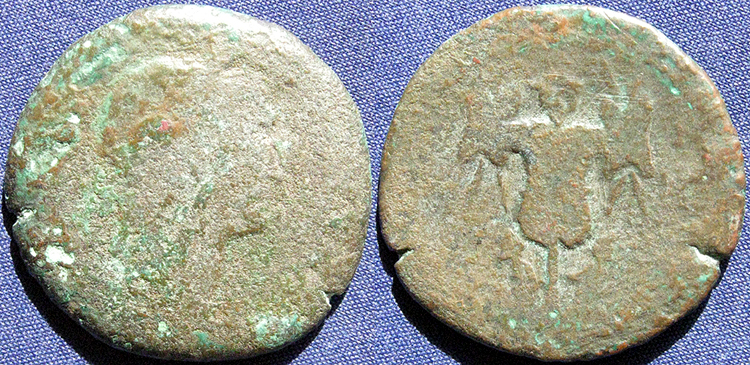
(No legend)
Tyche-Nemesis standing facing, wings spread, rudder in left hand,
cornuopiae in right
L | IΓ (?) across fields
33mm, 17.81g
Emmett 606 (5)
|
 |
Roman Provincial, Egypt-Alexandria,
Trajan, AE Drachm, 111/112 (Year 15?)
AVT TPAIAN CE_B ΓEPM ΔAKIK
Laureate head right, aegis on left shoulder
(No legend)
Zeus standing left in distyle temple with lotus flower columns, sun-disk
in pediment
L | IE (?) across fields
33mm x 34mm, 19.19g
Emmett 617 (5d)
Note: This could be Year 13, but the bottom of the right character looks
like it extends past the stroke, so I'm leaning toward Year 15.
|
 |
Roman Provincial, Egypt-Alexandria,
Trajan, AE Obol, 108/109 (Year 12)
AVT TPAIAN CEB-ΓEPM ΔAKIK
Laureate head right
(No legend)
Eagle standing left, head right, wings open
L IB in exergue
18mm x 19mm, 4.76g
Emmett 670A (5); Dattari 1192
Ex CNG, Sale 43, Lot 1155, September 1997
|
 |
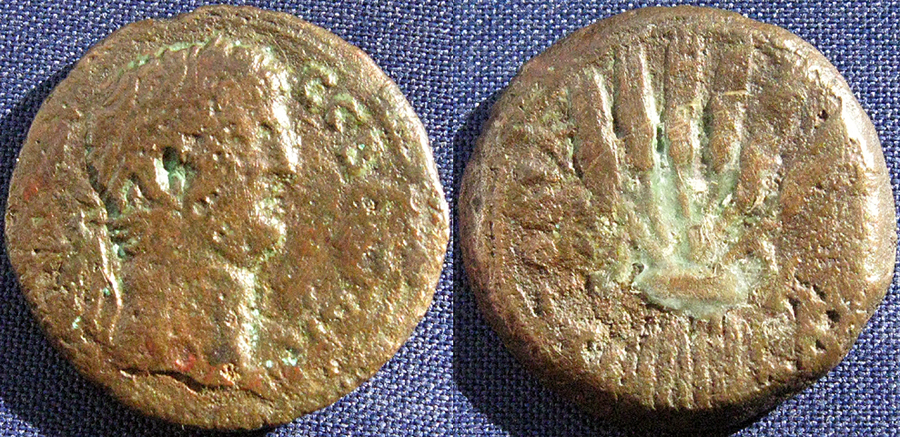
Roman Provincial, Egypt-Alexandria, Trajan, AE Dichalkon, 113/114 (Year 17)
(No legend)
Laureate head right
(No legend)
Hem-hem crown
L I | Z across fields
12mm x 14mm, 1.41g
Emmett 707 (4)
|
 |
Roman Provincial, Egypt-Alexandria,
Trajan, AE Dichalkon, 113/114 (Year 17)
(No legend)
Laureate head right
(No legend)
Hem-hem crown
L I | Z across fields
13mm x 15mm, 1.65g
Emmett 707 (4)
|
 |
Roman Provincial, Egypt-Alexandria,
Trajan, AE Dichalkon, 113/114 (Year 17)
(No legend)
Laureate head right
(No legend)
Hippopotamus standing right
L IZ above
13mm x 15mm, 1.62g
Emmett 708 (5)
Note: Dotted border on reverse is 12mm diameter
|
 |
Roman Provincial, Egypt-Alexandria,
Trajan, AE Dichalkon, 113/114 (Year 17)
(No legend)
Laureate head right
(No legend)
Rhinoceros standing right
L IZ above
13mm x 14mm, 1.02g
Emmett 719 (5)
Ex Keith Emmett Collection, December 2007; Ex eBay Auction,
May 2001
Note: Dotted border on reverse is 10mm diameter
|
 |
Roman Provincial, Egypt-Alexandria,
Trajan, AE Dichalkon, 109/110 (Year 13)
(No legend)
Laureate head right
(No legend)
Sistrum
L | IΓ across fields
13mm x 14mm, 1.70g
Emmett 720 (3); Dattari 1114
|
 |
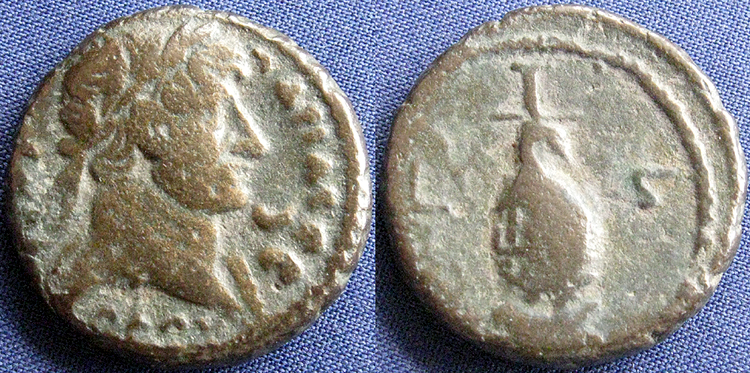
Roman Provincial, Egypt-Alexandria,
Trajan, AE Dichalkon, 112/113 (Year 16)
(No legend)
Laureate head right, dotted border
(No legend)
Oinochoe (one-handled jug)
L | IV across fields
13mm x 15mm, 1.17g
Emmett 726 (5)
Note: Dotted border on reverse is 10mm diameter
|
 |
Roman Provincial, Egypt-Alexandria,
Trajan, AE Dichalkon, 112/113 (Year 16)
(No legend)
Laureate head right, line border
(No legend)
Atef crown
L | IV across fields
13mm x 15mm, 1.82g
Emmett --
Ex Zuzim Judea, VCoins, March 2008 (Misattributed as Emmett 710
(Crown of Isis))
Note: Dotted border on obverse is ~10mm diameter
|
| Hadrian:
117-138 |
 |
Roman Provincial, Egypt-Alexandria,
Hadrian, AR Tetradrachm, 125/126 (Year 10)
AYT KAI-TPAI AΔPIA CEB
Laureate, draped, cuirassed bust right, seen from behind
L Δ_EK_ATOY
Agathodaemon erect right at left, wearing skhent and enfolding caduceus,
facing Uraeus erect left at right, wearing disk and horns, enfolding
sistrum, their tails knotted together and holding a club erect
23mm x 24mm, 13.17g
Emmett 804 (1); Köln 894; Dattari 1552; BMC 668; Milne 1164; Curtis 351;
Demetrio 1247
|
 |
Roman Provincial, Egypt-Alexandria, Hadrian, AR Tetradrachm, 121/122 (Year 6)
AVT KAI-TPAI-AΔPIA CEB
Laureate bust right, drapery on left shoulder, crescent in right field
(No legend)
Canopic jar of Osiris standing right
L | Ϛ across fields
23mm x 24mm, 11.18g
Emmett 827 (1)
|
 |
Roman Provincial, Egypt-Alexandria,
Hadrian, AR Tetradrachm, 125/126 (Year 10)
AVT KAI-TPAI AΔPIA CEB
Laureate, draped, cuirassed bust right, seen from behind
L ΔEK_ATOY
Canopic jar of Osiris standing right
23mm x 25mm, 13.19g
Emmett 827 (1)
Ex CNG, Auction 69, June 8, 2005, Lot 1284
|
 |
Roman Provincial, Egypt-Alexandria,
Hadrian, AR Tetradrachm, 125/126 (Year 10)
AVT KAI-TPAI AΔPIA CEB
Laureate, draped, cuirassed bust right, seen from behind
L Δ_E_KATOV
Elpis standing left, flower upward in right hand, hitching skirt with left
24mm x 26mm, 12.97g
Emmett 839 (2)
|
 |
Roman Provincial, Egypt-Alexandria,
Hadrian, AR Tetradrachm, 128/129 (Year 13)
AVT KAI-TPAI AΔPIA CEB
Laureate, draped, cuirassed bust right, seen from behind
ΠATPH / ΠATPIOΔOC
Clasped hands
L | IΓ across fields
24mm x 26mm, 11.76g
Emmett 848 (1)
|
 |
Roman Provincial, Egypt-Alexandria,
Hadrian, AR Tetradrachm, 128/129 (Year 13)
AVT KAI-TPAI AΔPIA CEB
Laureate, draped, cuirassed bust right, seen from behind
ΠATPH / ΠATPIOΔOC
Clasped hands
L | IΓ across fields
26mm x 27mm, 13.16g
Emmett 848 (1)
|
 |
Roman Provincial, Egypt-Alexandria,
Hadrian, Billon Tetradrachm, 132/133 (Year 17)
AUT KAIC-TRAI
ADRIA CEB
Laureate, draped, cuirassed bust right, seen from behind
CABINA-CEBACTH | IZ / L
Draped bust of Sabina right, hair coiled and piled on top of head behind
metal tiara
24mm x 25mm, 12.44g
Emmett 886 (1)
Ex Keith Emmett Collection; Ex CNA, July 1984
|
 |
Roman Provincial, Egypt-Alexandria,
Hadrian, AR Tetradrachm, 134/135 (Year 19)
AYT KAIC TPAIAN-AΔPIANOC CEB
Laureate head left
LENN_EAKΔ
Draped bust of Serapis right, wearing kalathos
22mm x 24mm, 12.45g
Emmett 889 (1); Milne 1445
|
 |
Roman Provincial, Egypt-Alexandria,
Hadrian, AR Tetradrachm, 133/134 (Year 18)
AYT KAIC TPAIAN •-AΔPIANOC CEB
Laureate, draped, cuirassed bust right, seen from behind
(No legend)
Serapis enthroned left, scepter in left hand, pointing with right hand at
Cerberus seated left at feet
L I | H across fields
23mm x 24mm, 13.67g
Emmett 892 (1)
|
 |
Roman Provincial, Egypt-Alexandria,
Hadrian, AE Drachm, 129/130 (Year 14)
AVT KAI-TPAI AΔPIA CEB
Laureate, draped, cuirassed bust right, seen from behind
(No legend)
Athena standing facing, helmeted head left, Nike in right hand, left hand
resting on shield set on ground
IΔ | L across fields
33mm x 35mm, 21.19g
Emmett 925 (1)
|
 |
Roman Provincial, Egypt-Alexandria,
Hadrian, AE Drachm, 129/130 (Year 14)
AVT KAI-TPAI AΔPIA CEB
Laureate, draped, cuirassed bust right, seen from behind
(No legend)
Athena standing facing, helmeted head left, Nike in right hand, left hand
resting on shield set on ground
IΔ | L across fields
34mm x 36mm, 25.29g
Emmett 925 (1)
|
 |
Roman Provincial, Egypt-Alexandria,
Hadrian, AE Drachm, 133/134 (Year 18)
AVT KAIC TPAIAN-AΔPIANOC CEB
Laureate, draped, cuirassed bust right, seen from behind
(No legend)
Canopi of Harpokrates (left) and Isis (right) standing facing each other
L | I | H across fields
33mm x 34mm, 24.10g
Emmett 937 (5); Milne 1419
|
 |
Roman Provincial, Egypt-Alexandria,
Hadrian, AE Drachm, 132/133 (Year 17)
AVT KAI-TPAI AΔPIA CEB
Laureate bust right, aegis on left shoulder
(No legend)
Dioskouroi standing facing, heads turned toward each other, vertical spear
in outer hand, parazonium in inner hand
L | IZ across fields
34mm x 35mm, 21.72g
Emmett 950 (2); BMC 708; Milne 1406
|
 |
Roman Provincial, Egypt-Alexandria,
Hadrian, AE Drachm, 117-138
AVT KAI-TPAI AΔPIA CEB
Laureate bust right, aegis on left shoulder
(No legend)
Elpis standing left, flower upward in right hand, hitching skirt with left
33mm x 34mm, 28.32g
Emmett 956 (2)
|
 |
Roman Provincial, Egypt-Alexandria,
Hadrian, AE Drachm, 117/118 (Year 2)
AVT KAIC TPAIANOC-AΔPIANOC
Laureate head right, drapery on left shoulder
(No legend)
Hadrian standing in slow quadriga right, scepter in left hand, wreath (?) in
right
L B in upper right field
32mm x 34mm, 18.82g
Emmett 960 (2)
|
 |
Roman Provincial, Egypt-Alexandria,
Hadrian, AE Drachm, 130/131 (Year 15)
AVT KAI-TPAI AΔPIA CEB
Laureate, draped, cuirassed bust right, seen from behind
(No legend)
Hadrian standing left in robes, scepter in left hand, clasping right hands
with Alexandria standing right, head bowed, grain ears in left hand
L | IE across fields
34mm x 35mm, 21.65g
Emmett 964 (1); Milne 1315
Note: This is part of the Hadrian travel series from his second empire
tour.
|
 |
Roman Provincial, Egypt-Alexandria,
Hadrian, AE Drachm, 130/131 (Year 15)
AVT KAI-TPAI AΔPIA CEB
Laureate, draped, cuirassed bust right, seen from behind
(No legend)
Hadrian standing left in robes, scepter in left hand, clasping right hands
with Alexandria standing right, head bowed, grain ears in left hand
L | IE across fields
34mm x 36mm, 19.08g
Emmett 964 (1); Milne 1315; Dattari 1610
|
 |
Roman Provincial, Egypt-Alexandria,
Hadrian, AE Drachm, 133/134 (Year 18)
AVT KAIC TPAIAN-AΔPIANOC CEB
Laureate, draped, cuirassed bust right, seen from behind
(No legend)
Isis Pharia standing right, Harpokrates on left arm, sistrum and sail in
right hand, Pharos to right
L / I | H across fields
31mm x 33mm, 21.87g
Emmett 1002 (1)
|
 |
Roman Provincial, Egypt-Alexandria,
Hadrian, AE Drachm, 133/134 (Year 18)
AVT KAIC TPAIAN-AΔPIANOC CEB
Laureate bust right, aegis on left shoulder
(No legend)
Nilus reclining left, reeds in right hand, cornucopiae in left and leaning on crocodile
L IH in left field
32mm x 34mm, 21.14g
Emmett 1014 (1)
|
 |
Roman Provincial, Egypt-Alexandria,
Hadrian, AE Drachm, 133/134 (Year 18)
AVT KAIC TPAIAN • -AΔPIANOC CEB
Laureate bust right, aegis on left shoulder
(No legend)
Nilus reclining left, reeds in right hand, cornucopiae in left and leaning on crocodile
L IH in left field
32mm x 33mm, 24.53g
Emmett 1014 (1)
|
 |
Roman Provincial, Egypt-Alexandria,
Hadrian, AE Drachm, 117-138 (Uncertain Year)
AVT KAI-TPAI AΔPIA CEB
Laureate, draped, cuirassed bust right, seen from behind
(No legend)
Nilus seated left on rocks, reeds in left hand, cornucopiae in right and leaning on crocodile
33mm x 34mm, 21.82g
Emmett 1016
|
 |
Roman Provincial, Egypt-Alexandria,
Hadrian, AE Drachm, 132/133 (Year 17)
AVT KAIC TPAIAN-AΔPIANOC CEB
Laureate, draped, cuirassed bust right, seen from behind
AΔP / IA / NON
Serapis standing right, scepter in left hand, right hand raised, facing
emperor standing left, scepter in left hand, right hand on altar with
legend, all in distyle temple
L | IZ across fields
33mm x 34mm, 20.74g
Emmett 1042 (1)
|
 |
Roman Provincial, Egypt-Alexandria,
Hadrian, AE Drachm, 123/124 (Year 8)
AVT KAI TPAI-AΔPIA CEB
Laureate bust right
(No legend)
Sphinx seated right
L | H across fields
34mm, 17.67g
Emmett 1054 (4)
|
 |
Roman Provincial, Egypt-Alexandria,
Hadrian, AE Drachm, 123/124 (Year 8)
AVT KAI TPAI-AΔPIA CEB
Laureate bust right, aegis on left shoulder
(No legend)
Tyche reclining left on couch, leaning on left arm on rocks, rudder in
right hand and extending into exergue
L H in left field
33mm x 35mm, 18.93g
Emmett 1063 (4)
|
 |
Roman Provincial, Egypt-Alexandria,
Hadrian, AE Hemidrachm, 132/133 (Year 17)
AVT KAIC TPAIAN-AΔPIANOC CEB
Laureate, draped, cuirassed bust right, seen from behind
(No legend)
Pharos
L | IZ across fields
27mm x 29mm, 13.62g
Emmett 1103 (1); Dattari 3025 var (date)
Ex Stack's, Public Auction Sale, Lot 615, February 26, 1955 (with
envelope)
|
 |
Roman Provincial, Egypt-Alexandria,
Hadrian, AE Diobol, 126/127 (Year 11)
AVT KAIC TPAIAN-AΔPIANOC CEB
Laureate head right, drapery on left shoulder
L ENΔEKATOV
Apis bull standing right, facing altar surmounted by sun disk
23mm x 24mm, 8.09g
Emmett 1114 (5)
|
 |
Roman Provincial, Egypt-Alexandria,
Hadrian, AE Diobol, 133/134 (Year 18)
AVT KAIC TPAIAN-AΔPIANOC CEB
Laureate, draped bust right
(No legend)
Apis bull standing right, facing altar surmounted by sun disk
L IH in upper field
23mm x 24mm, 8.47g
Emmett 1114 (1)
|
 |
Roman Provincial, Egypt-Alexandria,
Hadrian, AE Obol, 136/137 (Year 21)
AVT KAIC TPA-AΔPIANOC CEB
Laureate head right, slight drapery over left shoulder
(No legend)
Kalathos filled with poppies and grain, between two torches
L KA in exergue
20mm x 21mm, 5.68g
Emmett 1166 (1)
|
 |
Roman Provincial, Egypt-Alexandria,
Hadrian, AE Obol, 126/127 (Year 11)
AVT KAI TPAI-AΔPIA CEB
Laureate head right, slight drapery over left shoulder
(No legend)
Stag standing right
L | IA across fields
19mm x 20mm, 4.47g
Emmett 1169 (1)
|


|
Roman Provincial, Egypt-Alexandria,
Hadrian, AE Dichalkon, 124/125 (Year 9)
(No legend)
Laureate head right, slight drapery over left shoulder, I in right field, all in
border of dots
(No legend)
Three corn ears, tied together at bottom
L | ΔE across fields
11mm x 12mm, 1.12g
Emmett 1176 (5)
Note: Dotted border on reverse is 8mm diameter
|
 |
Roman Provincial, Egypt-Alexandria,
Hadrian, AE Dichalkon, 129/130 (Year 14)
(No legend)
Laureate head right, slight drapery over left shoulder
(No legend)
Three corn ears, tied together at bottom
L | ID across fields
11mm x 12mm, 1.07g
Emmett 1176 (5)
Note: Dotted border on reverse is 8mm diameter
|
 |
Roman Provincial, Egypt-Alexandria,
Hadrian, AE Dichalkon, 125/126 (Year 10)
(No legend)
Laureate head right, drapery over left shoulder, I in right field
(No legend)
Cornucopiae
L D | E across fields
11mm x 13mm, 1.09g
Emmett 1177 (2)
Note: DE on the reverse for Hadrian is short for DEKATOU or Year 10,
instead of 4+5=9 as found on some ancient coins
Note: Dotted border on reverse is 8mm diameter
|
 |
Roman Provincial, Egypt-Alexandria,
Hadrian, AE Dichalkon, 119/120 (Year 4)
(No legend)
Laureate head right
(No legend)
Headdress of Isis
L | D across fields
13mm x 14mm, 1.38g
Emmett 1189
|
 |
Roman Provincial, Egypt-Alexandria,
Hadrian, AE Dichalkon, 132/133 (Year 17)
(No legend)
Laureate head right
(No legend)
Headdress of Isis
LI | Z across fields
11mm x 12mm, 1.08g
Emmett 1189 (Not attested for Year 17)
|
 |
Roman Provincial, Egypt-Alexandria,
Hadrian, AE Hemiobol, 117/118 (Year 2)
(No legend)
Laureate head right
(No legend)
Ibis standing right
LB above
13mm x 16mm, 2.47g
Emmett 1192 (5)
Ex Keith Emmett Collection, December 2007; Ex Bill Kalmbach
Collection, January 2000
|
 |
Roman Provincial, Egypt-Alexandria,
Hadrian, AE Dichalkon, 126/127 (Year 11)
(No legend)
Laureate head right, drapery over left shoulder, I in right field
(No legend)
Piloi (Caps) of Dioskouri
LIA below
11mm x 12mm, 1.03g
Emmett 1198 (1)
Note: Dotted border on reverse is 8mm diameter
|
 |
Roman Provincial, Egypt-Alexandria,
Hadrian, AE Hemiobol, 137/138 (Year 22)
(No legend)
Laureate head left
(No legend)
Pomegranate
L / K | B across field and below
13mm x 14mm, 2.03g
Emmett 1199 (5); BMC --; Milne --
Ex Keith Emmett Collection, December 2007;
Ex CNG, May 1993
|
 |
Roman Provincial, Egypt-Alexandria,
Hadrian, AE Hemiobol, 125/126 (Year 10)
(No legend)
Laureate head right, drapery over left shoulder
(No legend)
Sistrum
L | DE across fields
13mm x 15mm, 1.95g
Emmett 1202 (3)
Note: Dotted border on reverse is 10mm diameter
|
 |
Roman Provincial, Egypt-Alexandria,
Hadrian, AE Dichalkon, 126/127 (Year 11)
(No legend)
Laureate head right
(No legend)
Pan (?) standing right
L | IA across fields
11mm x 12mm, 1.40g
Emmett --
Note: Dotted border on reverse is 8mm diameter
|
| Antinoos:
134-137 |
 |
Roman Provincial, Egypt-Alexandria,
Antinoos, AE Drachm, 134/135 (Year 19)
ANTINOOV-HOwOC
Cloaked bust right, wearing hem-hem crown
(No legend)
Antinoos on horse back prancing right, caduceus in right hand
L | Q | I across fields
33mm x 34mm, 22.16g
Emmett 1346 (2); Köln 1276; Blum 9
Ex Münzen & Medaillen Deutschland GmbH, Auction 12, Lot
304, April 2003; Ex Edward J. Waddell, Ltd; Ex Dr. B. Peus Nachf.,
Frankfurt a. M. Sale 277, Lot 227, 1971
|
| Antoninus
Pius: 138-161 |
 |
Roman Provincial, Egypt-Alexandria,
Antoninus Pius, AR Tetradrachm, 147/148 (Year 11)
ANTωNINOC-CEBEV CEB
Laureate bust right
L EN_ΔE_KATOV
Apollo Didymaios (Milesios) standing left, bow in left hand
22mm x 24mm, 8.57g
Emmett 1359 (5)
|
 |
Roman Provincial, Egypt-Alexandria,
Antoninus Pius, AR Tetradrachm, 141/142 (Year 5)
AYT K • T • AIΛ AΔP-ANTωNINOC
Laureate bust right
(No legend)
Artemis running right, wearing short chiton with diplois drawn off right
shoulder, left breast exposed, raising right arm to quiver slung over
back, bow extended in left hand
L | E across fields
23mm x 25mm, 12.79g
Emmett 1362 (1); Köln 1362/1363; Dattari 2150; BMC 938; Milne 1693; Curtis --;
Demetrio 1604
|
 |
Roman Provincial, Egypt-Alexandria,
Antoninus Pius, AR Tetradrachm, 138/139 (Year 2)
AYT K T AIΛ AΔP-ANTωNINOC CEV CEB
Bare head right, drapery over left shoulder
ETO_VC
Canopic jar of Osiris standing right
B in right field
22mm x 24mm, 8.16g
Emmett 1373 (1)
|
 |
Roman Provincial, Egypt-Alexandria,
Antoninus Pius, AR Tetradrachm, 139/140 (Year 3)
AU_T K-T AIL ADR-ANTwNINOC
Bare head, draped, cuirassed bust right, seen from behind
L-TRI_TOU
Dikaiosyne (Aequitas) seated left on throne, scales in right hand,
cornucopiae in left
24mm x 25mm, 13.42g
Emmett 1377 (1)
Ex Thomas Beniak Collection; Ex Harlan J Berk, Sale 134, October 2003
|
 |
Roman Provincial, Egypt-Alexandria,
Antoninus Pius, AR Tetradrachm, 146/147 (Year 10)
ANTωNINO_C CEB EVCEB
Laureate head right
L ΔE_K_ATOV
Elpis standing left, flower upward in right hand, hitching skirt with left
22mm x 24mm, 13.16g
Emmett 1383 (1)
|
 |
Roman Provincial, Egypt-Alexandria,
Antoninus Pius, AR Tetradrachm, 143/144 (Year 7)
ANTωNINOC-CEB EYCEB
Laureate, draped, cuirassed bust right, seen from behind
(No legend)
Serapis enthroned left, vertical scepter in left hand, right hand extended
over Kerberos seated left by his feet
L | Z across fields
23mm x 24mm, 12.40g
Emmett 1431; Köln 1440/1441; Dattari 2366; BMC 983 var; Milne 1746/1747; Curtis
662;
Demetrio 1639 var
Ex Coin Galleries, New York, 18 November 1996
|
 |
Roman Provincial, Egypt-Alexandria,
Antoninus Pius, AR Tetradrachm, 143/144 (Year 7)
ANTωNINOC-CEB EYCEB
Laureate head right
(No legend)
Serapis enthroned left, vertical scepter in left hand, right hand extended
over Kerberos seated left by his feet
L | Z across fields
22mm x 23mm, 12.78g
Emmett 1431 (1); Köln 1440; Dattari 2366; BMC 983; Milne 1746; Curtis
662;
Demetrio 1639
|
 |
Roman Provincial, Egypt-Alexandria,
Antoninus Pius, AR Tetradrachm, 153/154 (Year 17)
ANTωNIN_O_C CEB EVCEB
Laureate head right
(No legend)
Tyche reclining left on lectistern, leaning on left hand
L IZ in upper left field
22mm x 23mm, 12.50g
Emmett 1437 (1); Milne 2201
|
 |
Roman Provincial, Egypt-Alexandria,
Antoninus Pius, AE Drachm, 145/146 (Year 9)
AVT K T AIΛ AΔP ANTωNINOC
Laureate head right
LENA_TOV
Agathodaemon standing erect right on back of horse standing right
30mm x 31mm, 21.63g
Emmett 1444 (--)
|
 |
Roman Provincial, Egypt-Alexandria,
Antoninus Pius, AE Drachm, 157/158 (Year 21)
AVT K T AIΛ AΔP ANTωNINOC CEB EVC
Laureate head right
(No legend)
Eagle standing facing, head right, wings open, wreath in beak
L A | K across fields
29mm x 31mm, 18.08g
Emmett 1494var. (date position) (3)
|
 |
Roman Provincial, Egypt-Alexandria,
Antoninus Pius, AE Drachm, 150/151 (Year 14)
AVT K T AIΛ AΔP-ANTωNINOC
Laureate, draped, cuirassed bust right, seen from behind
(No legend)
Winged Hieracosphinx-Nemesis seated right, wheel under left forepaw
I | Δ across fields, L in exergue
34mm x 35mm, 23.80g
Emmett 1524 (1)
|
 |
Roman Provincial, Egypt-Alexandria,
Antoninus Pius, AE Drachm, 146/147 (Year 10)
AYT K T AIΛ AΔP-ANTωNEINOC CEB EYC
Laureate, draped, cuirassed bust right, seen from behind
L ΔEK_A_TOV
Isis enthroned right, wearing horns, disk, plume, chiton and peplos,
suckling infant Harpokrates who wears skhent and holds a lotus bud in left
hand
33mm x 34mm, 23.76g
Emmett 1585; Köln 1548; Dattari 2649; BMC 1125; Milne 1919; Demetrio 1712
Ex Classical Numismatic Group, NYINC, January 2006
|
 |
Roman Provincial, Egypt-Alexandria,
Antoninus Pius, AE Drachm, 143/144 (Year 7)
AYT K T AIΛ AΔP-ANTωNEINOC CEB EYC
Laureate head right
(No legend)
Isis enthroned right, wearing horns, disk, plume, chiton and peplos,
suckling infant Harpokrates who wears skhent and holds a lotus bud in left
hand, all in distyle temple
L | Z across fields
33mm x 35mm, 26.72g
Emmett 1587; Milne 1769
|
 |
Roman Provincial, Egypt-Alexandria,
Antoninus Pius, AE Drachm, 148/149 (Year 12)
AVT K T AIΛ AΔP-ANTωNINOC-CEB-EVC
Laureate, draped bust right
L-ΔωΔE-KAT-OV
Isis Pharia standing right, billowing sail in both hands, sistrum in right
hand, Pharos to right
33mm x 34mm, 23.90g
Emmett 1592 (1)
|
 |
Roman Provincial, Egypt-Alexandria,
Antoninus Pius, AE Drachm, 145/146 (Year 9)
AVT K T AIΛ AΔP-ANTωNINOC-CEB EVC
Laureate head right
L ENATOV
Roma seated left on cuirass, Nike in right hand, parazonium in left,
shield behind
34mm x 35mm, 24.04g
Emmett 1644 (1)
|
 |
Roman Provincial, Egypt-Alexandria,
Antoninus Pius, AE Drachm, 148/149 (Year 12)
AVT K T AIΛ AΔP-ANTωNINOC-CEB EVC
Laureate, draped, cuirassed bust right
ΔωΔE-KATOV
Serapis enthroned left in temple, Kerberos at feet
L in exergue
32mm x 34mm, 19.38g
Emmett 1668 (1)
|
 |
Roman Provincial, Egypt-Alexandria,
Antoninus Pius, AE Drachm, 148/149 (Year 12)
AVT K T AIΛ AΔP-ANTωNINOC-CEB EVC
Laureate head right
ΔωΔE-KATOV
Tyche standing left, cornucopiae in left hand, right hand on rudder
33mm x 34mm, 23.31g
Emmett 1685 (1); Dattari 2878
|
 |
Roman Provincial, Egypt-Alexandria,
Antoninus Pius, AE Drachm, 151/152 (Year 15)
AVT K T AIΛ AΔP-ANTωNINOC-CEB EVC
Laureate head right
(No legend)
Tyche reclining left on couch adorned with festoons, leaning on left arm,
rudder in right hand
L IE in left field
33mm x 35mm, 26.23g
Emmett 1687 (1)
|
 |
Roman Provincial, Egypt-Alexandria,
Antoninus Pius, AE Hemiobol, 138/139 (Year 2)
(No legend)
Bare head right
(No legend)
Headdress of Isis
L | B across fields
13mm x 15mm, 1.97g
Emmett 1800 (5)
Ex Keith Emmett Collection, December 2007; Ex Bill Kalmback
Collection, January 2000
|
| Faustina
II: (for Antoninus Pius as Augustus) 147-161, (for Marcus Aurelius as Augustus)
161-170 |
 |
Roman Provincial, Egypt-Alexandria,
Faustina II, Billon Tetradrachm, 151/152 (Year 15 of Antoninus Pius)
ΦAVCTINA-CEBACTH
Pearl-diademed, draped bust right, hair in waves, bun at back of head with
log braid carried across top of head and tucked under diadem
(No legend)
Dikaiosyne standing left, scales in right hand,
cornucopiae in left
L I | E across fields
21mm x 23mm, 13.30g
Emmett 1937 (3)
|
 |
Roman Provincial, Egypt-Alexandria,
Faustina II, AE Tetradrachm, 153/154 (Year 17 of Antoninus Pius)
ΦAVCTINA-CEBACTH
Pearl-diademed, draped bust right, hair in waves, bun at back of head with
log braid carried across top of head and tucked under diadem
(No legend)
Dikaiosyne (Aequitas) seated left on throne, scales in right hand,
cornucopiae in left
I / L | Z across fields (Z is retrograde)
21mm x 22mm, 11.95g
Emmett 1938 (4)
|
| Marcus
Aurelius: (as Caesar) 141-161, (as Augustus) 161-180 |
 |
Roman Provincial, Egypt-Alexandria,
Marcus Aurelius as Augustus, AR Tetradrachm, 161/162 (Year 2)
M AVPHΛIOC-ANTωNINOC CEB
Laureate bust right
(No legend)
Bust of Nike right
L | B across fields
22mm x 23mm, 9.53g
Emmett 2067 (1)
|
 |
Roman Provincial, Egypt-Alexandria,
Marcus Aurelius as Augustus, AE Drachm, 165/166 (Year 6)
M AVPHΛIOC-ANTωNINOC CEB
Laureate head left
CEMACIA
Semasia galloping left on horse
L | S across fields
31mm x 32mm, 20.85g
Emmett 2188 (1)
|
| Lucius
Verus: 161-169 |
 |
Roman Provincial, Egypt-Alexandria, Lucius Verus, AE Drachm, 164/165 (Year
5)
Λ AVPHΛIOC-OVHPOC CEB
Laureate head left
(No legend)
Isis Euploia standing facing in harbor, cornucopiae in left hand, vertical
rudder in right, between Nile boat and Mediterranean galley, Nilus and
Euthenia reclining left and right toward her feet
E / L in right field
29mm x 31mm, 17.82g
Emmett 2397 (4); Dattari 3725
|
| Commodus:
(as Caesar) 174-180, (as Augustus) 180-192 |
 |
Roman Provincial, Egypt-Alexandria,
Commodus, AE Tetradrachm, 181/182 (Year 22, Sole Reign)
M AVPH KOMMO ANTωNINOC CE
Laureate head right
(No legend)
Athena seated left on shield, Nike on outstretched right arm, spear in
left hand
KB / L in left field
23mm x 25mm, 13.06g
Emmett 2521 (1)
|
 |
Roman Provincial, Egypt-Alexandria,
Commodus, AE Tetradrachm, 188/189 (Year 29, Sole Reign)
M A KOM ANTW-CEBEY CEB
Laureate head right
(No legend)
Galley sailing right, Pharos at left
L KΘ in exergue
23mm x 24mm, 11.90g
Emmett 2542 (1)
Note: The Pharos is the Lighthouse of Alexandria, the last of the seven Wonders
of the ancient world. The lighthouse was on the north-west coast of the
Egyptian delta and took the name "Pharos" from the island in
front of the harbor on which it was built. Afterwards, pharos became the
generic term for lighthouses.
|
 |
Roman Provincial, Egypt-Alexandria,
Commodus, AE Tetradrachm, 189/190 (Year 30, Sole Reign)
M A KOM ANTW-CEBEY CEB
Laureate head right
(No legend)
Bust of Selene left, facing large crescent
L Λ in right field
23mm x 24mm, 13.11g
Emmett 2558 (1); Milne 2686
|
| Elagabalus:
218-222 |
 |
Roman Provincial, Egypt-Alexandria, Elagabalus, AR Tetradrachm, 221/222 (Year 5)
A KAICAP MA AVP-ANTωNINO CEVCEB
Laureate, draped bust right, seen from behind
(No legend)
Ares standing facing, helmeted head left, reversed vertical spear in right
hand, parazonium in left, shield in background at left
L E in left field
22mm x 23mm, 14.61g
Emmett 2912 (2)
|
 |
Roman Provincial, Egypt-Alexandria, Elagabalus, Billon Tetradrachm, 221/222 (Year 5)
A KAICAP MA AVP-ANTωNINO CEVCEB
Laureate, draped bust right, seen from behind
(No legend)
Helmeted, cuirassed bust of Athena right
L E in right field
23mm x 25mm, 12.76g
Emmett 2914 (1)
|
 |
Roman Provincial, Egypt-Alexandria, Elagabalus, AR Tetradrachm, 221/222 (Year
5?)
A KAICAP MA AVP-ANTωNINO CEVCEB
Laureate, draped bust right, seen from behind
(No legend)
Radiate bust of Helios Hermanubis right, palm in right field
L E (?) in left field
22mm x 23mm, 12.79g
Emmett 2934 (1)
|
| Severus
Alexander: (as Caesar) 221-222, (as Augustus) 222-235 |
 |
Roman Provincial, Egypt-Alexandria,
Severus Alexander as Caesar, Billon Tetradrachm, 221/222 (Year 5)
MAR AUR ALEXANDROC
KAICAR
Bare head, draped bust right
(No legend)
Athena standing left, Nike in right hand, left resting on shield set on
ground
LE in left field
24mm x 25mm, 13.09g
Emmett 3073
Ex Keith Emmett Collection; Ex Colosseum Coin Exchange, June 1993
|
 |
Roman Provincial, Egypt-Alexandria,
Severus Alexander as Augustus, AE Tetradrachm, 231/232 (Year 11)
A KAI MAP AVP CEV-AΛEΞANΔPOC
Laureate, draped, cuirassed bust right, seen from behind
(No legend)
Bust of Serapis right, wearing kalathos, vertical palm to right
L IA in left field
23mm x 25mm, 13.72g
Emmett 3133 (2)
|
 |
Roman Provincial, Egypt-Alexandria,
Severus Alexander as Augustus, AE Tetradrachm, 234/235 (Year 14)
A KAI MAR AUR CEU-ALEXANDROC
Laureate, draped, cuirassed bust right
(No legend)
Zeus seated left on throne, patera in right hand, vertical scepter in
left, eagle on ground at left and looking back, decennalia palm vertical behind
throne
L ID in left field
23mm x 24mm, 11.93g
Emmett 3146 (2)
Note: Emmett noted in private correspondence with me "the palm is a
mark of the decennalia of the emperor and generally occurs on coins of
years 10 and higher -- they also occur on Gallienus' coins. I generally
only indicate a palm in the description if it is part of the motif: eagle
standing right, palm on wing -- is included because the type also occurs
on coins which are not decennalia issues. That's why you do not see the
palm description on the year 14 Gallienus "eagle types", which
all have a decennalia palm." Emmett also noted "the year 14
issues of Severus Alexander all have the Milne k bust types (front view)
-- the year 11 coins have type k2 (backview), which is how to confirm the
date reading on worn specimens."
|
| Maximinus
I Thrax: 235-238 |
 |
Roman Provincial, Egypt-Alexandria, Maximinus I Thrax, Billon Tetradrachm,
237/238 (Year 4)
AVTO MAΞIMINO CEV CEB
Laureate, cuirassed bust right, seen from behind
(No legend)
Nike enthroned left, wreath upward in right hand, long palm in left over
shoulder
L Δ in left field
21mm x 24mm, 13.41g
Emmett 3291 (1); BMC 1791
|
| Gordian
III: (as Caesar) 238, (as Augustus) 238-244 |
 |
Roman Provincial, Egypt-Alexandria,
Gordian III, Billon Tetradrachm, 243/244 (Year 7)
A K M ANT ΓOPΔIANO CEY
Laureate, draped, cuirassed bust right, seen from behind
(No legend)
Bare bust of Hermanubis right, drapery on left shoulder, caduceus with
grain ear to right
Z / L in left field
21mm x 24mm, 13.41g
Emmett 3409
Ex Keith Emmett Collection; Ex Colosseum Coin Exchange, December 1993
|
 |
Roman Provincial, Egypt-Alexandria,
Gordian III, Billon Tetradrachm, 242/243 (Year 6)
A K M ANT ΓO_PΔIANO CEY
Laureate, draped, cuirassed bust right, seen from behind
(No legend)
Zeus enthroned left, patera in right hand, long vertical scepter in left,
eagle at feet to left
L S in left field
22mm x 23mm, 11.31g
Emmett 3434 (1); BMC 1858
|
| Philip
I: 244-249 |
 |
Roman Provincial, Egypt-Alexandria,
Philip I, AE Tetradrachm, 244/245 (Year 2)
A K M IOV ΦI_ΛIΠΠO CEV CEB
Laureate, cuirassed bust right
(No legend)
Serapis standing facing, modius on head right, vertical scepter in right hand
L | B across fields
22mm x 24mm, 13.15g
Emmett 3506 (1); Milne 3553
|
 |
Roman Provincial, Egypt-Alexandria,
Philip I, AE Tetradrachm, 245/246 (Year 3)
A K M IOV ΦI_ΛIΠΠO CEV CEB
Laureate, cuirassed bust right
(No legend)
Serapis standing facing, modius on head right, vertical scepter in right
hand
L | Γ across fields
22mm x 23mm, 12.14g
Emmett 3506 (3)
|
| Philip
II: (as Caesar) 244-247, (as Augustus) 247-249 |
 |
Roman Provincial, Egypt-Alexandria,
Philip II as Augustus, Billon Tetradrachm, 248/249 (Year 6)
A K M IOV ΦIΛ_IΠΠOC EVC
Laureate, cuirassed bust right, seen from behind
(No legend)
Laureate bust of Zeus right, chlamys over left shoulder
L | ς across fields
23mm x 24mm, 11.94g
Emmett 3612 (2)
|
 |
Roman Provincial, Egypt-Alexandria,
Philip II as Augustus, Billon Tetradrachm, 248/249 (Year 6)
A K M IOV ΦIΛ_IΠΠOC EVC
Laureate, cuirassed bust right, seen from behind
(No legend)
Zeus enthroned left, chlamys over shoulders, patera in right hand,
vertical scepter in left, eagle at feet
L | ς across fields
22mm x 23mm, 13.42g
Emmett 3613 (3)
|
| Otacilia
Severa: 244-249 |
 |
Roman Provincial, Egypt-Alexandria,
Otacilia Severa, AE Tetradrachm, 246/247 (Year 4 of Philip I)
MwT CE OVHPA CEMCT C
Diademed, draped bust right, hair weaved in straight lines and rows with
long plait looped at based
(No legend)
Eusebeia, veiled, standing facing, head left, box of perfumes in right
hand, right hand over lit altar to left
L D in left field
21mm x 22mm, 11.95g
Emmett 3549 variant (1 for type)
Ex Thomas Beniak Collection
Note: Emmett lists the obverse legend for year 4 as ending in CTPA or CT and does not attest any year ending with CTC.
|
| Valerian
I: 253-260 |
 |
Roman Provincial, Egypt-Alexandria,
Valerian I, Billon Tetradrachm, 258/259 (Year 6)
A K Π ΛIO VAΛEPIANO CEY EYC
Laureate, draped, cuirassed bust right
(No legend)
Eagle standing left, head right, wreath in beak
L | S across fields
21mm x 23mm, 11.55g
Emmett 3705 (1); Milne 4005; Dattari 2872; BMC 2148
|
 |
Roman Provincial, Egypt-Alexandria,
Valerian I, Billon Tetradrachm, 253/254 (Year 1)
A K Π ΛIO VAΛEPIANO CEY EYC
Laureate, draped, cuirassed bust right, seen from behind
(No legend)
Laureate, bare bust of Zeus right
L | A across fields
22mm x 24mm, 12.50g
Emmett 3723 (3)
Ex Keith Emmett Collection
|
| Gallienus:
(Joint reign with Valerian I) 253-260, (Sole reign) 261-268 |
 |
Roman Provincial, Egypt-Alexandria, Gallienus, AE Tetradrachm, 255/256 (Year
3, Joint Reign)
A K Π ΛIO V ΓAΛΛIHNOC EV EVC
Laureate, draped, cuirassed bust right
(No legend)
Eagle standing left with spread wings, head right, wreath in beak
L | Γ across fields
21mm x 22mm, 10.09g
Emmett 3730 (1)
|
 |
Roman Provincial, Egypt-Alexandria,
Gallienus, Billon Tetradrachm, 264/265 (Year 12, Sole Reign)
AVT K Π ΛIK ΓAΛΛIHNOC CEB
Laureate, cuirassed bust right
(No legend)
Athena standing facing, helmeted head left, vertical spear in right hand,
left hand resting on large shield set on ground and decorated with head of
Medusa, palm in right field
L IB in left field
22mm x 25mm, 9.12g
Emmett 3796; Milne 4098; Curtis 1578-1579; BMC 2164; Dattari 5228
|
 |
Roman Provincial, Egypt-Alexandria,
Gallienus, AE Tetradrachm, 261/262 (Year 9, Sole Reign)
AVT K Π ΛIK ΓAΛΛIHNOC CEB
Laureate, cuirassed bust right
(No legend)
Eagle standing left, palm on wing, wreath in beak
L | HA across fields
21mm x 24mm, 10.13g
Emmett 3802 (3)
Ex Jean Elsen, Auction 85, Lot 475, September 2005
|
 |
Roman Provincial, Egypt-Alexandria,
Gallienus, AE Tetradrachm, 262/263 (Year 10, Sole Reign)
AVT K Π ΛIK ΓAΛΛIHNOC CEB
Laureate, draped, cuirassed bust right
(No legend)
Eagle standing left, head right, wreath in beak, vertical palm to left
L I in right field
22mm x 24mm, 10.99g
Emmett 3804 (1)
|
 |
Roman Provincial, Egypt-Alexandria,
Gallienus, AE Tetradrachm, 267/268 (Year 15, Sole Reign)
AVT K Π ΛIK ΓAΛΛIHNOC CEB
Laureate, cuirassed bust right
(No legend)
Eagle standing right, head left, wreath in beak, vertical palm to left
IE / L in right field
20mm x 21mm, 10.56g
Emmett 3807 (1); Milne 4178-80
|
 |
Roman Provincial, Egypt-Alexandria,
Gallienus, AE Tetradrachm, 265/266 (Year 13, Sole Reign)
AYT K Π ΛIK ΓAΛΛIHNOC CEB
Laureate, draped, cuirassed bust right, seen from behind
(No legend)
Eirene standing left, wearing chiton and peplos, olive branch upward in
right hand, long transverse scepter in left
L IΓ | vertical palm across fields
20mm x 22mm, 9.00g
Emmett 3810; Köln 2929; Dattari 5236; BMC 2177; Milne 4114; Curtis X-1597;
Demetrio 3090
|
 |
Roman Provincial, Egypt-Alexandria, Gallienus, AE Tetradrachm, 266/267 (Year 14, Sole Reign)
AVT K Π ΛIK ΓAΛΛIHNOC CEB
Laureate, cuirassed bust right
(No legend)
Nike advancing right, wreath upward in both hands, long palm over left
shoulder
L IΔ in right field
22mm x 23mm, 9.88g
Emmett 3821 (2)
|
 |
Roman Provincial, Egypt-Alexandria,
Gallienus, AE Tetradrachm, 265/266 (Year 13, Sole Reign)
AVT K Π ΛIK ΓAΛΛIHNOC CEB
Laureate, draped, cuirassed bust right, seen from behind
(No legend)
Nike standing facing, head left, wings spread, wreath upward in right
hand, long vertical palm in left
L | IΓ across fields
20mm x 22mm, 9.60g
Emmett 3823 (1); Milne 4117
|
 |
Roman Provincial, Egypt-Alexandria,
Gallienus, Billon Tetradrachm, 263/264 (Year 11, Sole Reign)
AVT K Π ΛIK ΓAΛΛIHNOC CEB
Laureate, draped, cuirassed bust right, seen from behind
(No legend)
Laureate, bare bust of Zeus right
L I | A across fields
22mm x 23mm, 9.29g
Emmett 3841
Ex Keith Emmett Collection; Ex Dussen, November 1994
|
| Salonina:
(under Gallienus as joint reign with Valerian I) 253-260, (under Gallienus as
sole reign) 261-268 |
 |
Roman Provincial, Egypt-Alexandria, Salonina, AE Tetradrachm, 266/267 (Year
14)
KOPNHΛIA CAΛωNEINA CEB
Draped bust right, hair weaved in rows with long plait coiled at back of
head, wearing stephane
(No legend)
Eagle standing left with spread wings, wreath in beak, palm behind
L IΔ in left field
22mm x 23mm, 9.06g
Emmett 3852 (1); Milne 4151
|
 |
Roman Provincial, Egypt-Alexandria, Salonina, AE Tetradrachm, 266/267 (Year
14)
KOPNHΛIA CAΛωNEINA CEB
Draped bust right, hair weaved in rows with long plait coiled at back of
head, wearing stephane
(No legend)
Eagle standing left with spread wings, wreath in beak, palm behind
IΔ / L in left field
22mm x 24mm, 10.55g
Emmett 3852 (1)
|
 |
Roman Provincial, Egypt-Alexandria,
Salonina, AE Tetradrachm, 267/268 (Year 15)
KOPNHΛIA CAΛωNEINA CEB
Draped bust right, hair weaved in rows with long plait coiled at back of
head, wearing stephane
(No legend)
Eagle standing right with spread wings, wreath in beak, palm behind
L IE in right field
20mm x 22mm, 9.04g
Emmett 3854 (1); Milne 4189; Curtis 1642; BMC 2280
|
 |
Roman Provincial, Egypt-Alexandria,
Salonina, AE Tetradrachm, 264/265 (Year 12)
KOPNHΛIA CAΛωNEINA CEB
Draped bust right, hair weaved in rows with long plait coiled at back of
head, wearing stephane
(No legend)
Elpis standing left, flower upward in right hand, hitching skirt with
left, palm in left field
L IB in right field
21mm x 23mm, 8.71g
Emmett 3856 (1)
Note: the B in the regnal date is completely filled on the die and only
the ghost of an outline make it to the coin.
|
| Claudius
II: 268-270 |
 |
Roman Provincial, Egypt-Alexandria,
Claudius II, AE Tetradrachm, 268/269 (Year 2)
AVT K KΛAV_ΔIOC CEB
Laureate, draped, cuirassed bust right, seen from behind
(No legend)
Eagle standing right, palm on wing, wreath in beak
L | B across fields
22mm x 23mm, 10.67g
Emmett 3877 (1)
|
 |
Roman Provincial, Egypt-Alexandria,
Claudius II, AE Tetradrachm, 269/270 (Year 3)
AVT K KΛAVΔIOC CEB
Laureate, draped, cuirassed bust right, seen from behind
(No legend)
Eagle standing right, palm on wing, wreath in beak
L | Γ across fields
20mm x 22mm, 9.47g
Emmett 3877 (1)
|
 |
Roman Provincial, Egypt-Alexandria,
Claudius II, AE Tetradrachm, 268/269 (Year 2)
AVT K KΛAV_ΔIOC CEB
Laureate, draped, cuirassed bust right, seen from behind
(No legend)
Eagle standing right, head left, wreath in beak
L | B across fields
20mm x 23mm, 10.34g
Emmett 3878 (1)
|
 |
Roman Provincial, Egypt-Alexandria,
Claudius II, AE Tetradrachm, 268/269 (Year 2)
AVT K KΛAV_ΔIOC CEB
Laureate, draped, cuirassed bust right, seen from behind
(No legend)
Eagle standing right, head left, wreath in beak
L | B across fields
20mm x 23mm, 10.23g
Emmett 3878 (1); Dattari 5412
|
 |
Roman Provincial, Egypt-Alexandria,
Claudius II, AE Tetradrachm, 268/269 (Year 2)
AVT K KΛAV_ΔIOC CEB
Laureate, draped, cuirassed bust right, seen from behind
(No legend)
Eagle standing right, head left, wreath in beak
L | B across fields
21mm x 22mm, 9.61g
Emmett 3878 (1); Dattari 5412
|
 |
Roman Provincial, Egypt-Alexandria,
Claudius II, AE Tetradrachm, 268/269 (Year 2)
AVT K KΛAV_ΔIOC CEB
Laureate, cuirassed bust right
(No legend)
Diademed bust of Hermanubis right, laurel ties falling across bare chest,
modius on head, caduceus surmounted by palm in right field
L B in left field
21mm x 23mm, 10.15g
Emmett 3883 (1)
|
 |
Roman Provincial, Egypt-Alexandria,
Claudius II, AE Tetradrachm, 268/269 (Year 2)
AVT K KΛA_VΔIOC CEB
Laureate, cuirassed bust right
(No legend)
Diademed bust of Hermanubis right, laurel ties falling across bare chest,
modius on head, caduceus surmounted by palm in right field
L B in left field
20mm x 21mm, 9.21g
Emmett 3883 (1); Milne 4240; BMC 2327
|
 |
Roman Provincial, Egypt-Alexandria,
Claudius II, AE Tetradrachm, 268/269 (Year 2)
AVT K KΛAV_ΔIOC CEB
Laureate, draped, cuirassed bust right, seen from behind
(No legend)
Nike flying right, wreath upward in right hand, palm in left over
shoulder
L | B across fields
20mm x 21mm, 7.11g
Emmett 3888 (2); Milne 4228; Curtis 1712; BMC 2321
|
 |
Roman Provincial, Egypt-Alexandria,
Claudius II, AE Tetradrachm, 268/269 (Year 2)
AVT K KΛAV_ΔIOC CEB
Laureate, cuirassed bust right
(No legend)
Jugate busts of Nilus and Euthenia right
L B in right field
21mm x 22mm, 10.46g
Emmett 3892 (1)
Ex Thomas Beniak Collection
|
 |
Roman Provincial, Egypt-Alexandria,
Claudius II, AE Tetradrachm, 268/269 (Year 2)
AVT K KΛAV_ΔIOC CEB
Laureate, draped, cuirassed bust right, seen from behind
(No legend)
Poseidon, nude, standing left, trident in left hand, sword/parazonium in
right hand, right foot on dolphin
L | B across fields
20mm x 22mm, 8.21g
Emmett 3893 (1); Milne 4252; Curtis 1718-9
|
 |
Roman Provincial, Egypt-Alexandria, Claudius II, AE Tetradrachm, 268/269 (Year 2)
AVT K KΛAV_ΔIOC CEB
Laureate, draped, cuirassed bust right, seen from behind
(No legend)
Poseidon, nude, standing left, trident in left hand, sword/parazonium in
right hand, right foot on dolphin
L | B across fields
20mm x 21mm, 9.05g
Emmett 3893 (1); Milne 4252; Curtis 1718-9
|
| Zenobia:
(as joint reign with usurper Vabalathus under Aurelian) 270-271 |
 |
Roman Provincial, Egypt-Alexandria,
Zenobia, AE Tetradrachm, 272 (Year 5)
CEΠTIM ZH_NOBIA CEB
Draped bust right, hair weaved in rows with braid along bottom at back of neck,
stephane in hair
(No legend)
Homonia standing left, right hand raised, double-cornucopiae in left
LE in left field
21mm x 23mm, 10.92g
Emmett 3912 (2); Dattari 5512
|
| Vaballathus:
(as joint reign with usurper Zenobia under Aurelian) 270-271 |
 |
Roman Provincial, Egypt-Alexandria,
Aurelian and Vaballathus, AE Tetradrachm, 270/271 (Year 1/Year 4)
A KΛ ΔOM AVPHΛIANOC CEB
Laureate, draped, cuirassed bust right, L | A across fields
IA CO VABAΛΛAΘOC AΘHNOV AVT CPω
Laureate, draped, cuirassed bust right, L | Δ across fields
20mm x 21mm, 9.65g
Emmett 3914 (1)
|
| Aurelian:
270-275 |
 |
Roman Provincial, Egypt-Alexandria,
Aurelian, AE Tetradrachm, 272/273 (Year 4)
A KΛ ΔOM AVPHΛIANOC CEB
Laureate, cuirassed bust right
(No legend)
Eagle standing left, wreath in beak
Δ / L | * across fields
21mm x 23mm, 10.59g
Emmett 3922 (1)
|
 |
Roman Provincial, Egypt-Alexandria,
Aurelian, AE Tetradrachm, 273/274 (Year 5)
A KΛ ΔOM AVPHΛIANOC CEB
Laureate, cuirassed bust right
ETOVC
Eagle standing left, head right, wings open, wreath in beak
E in right field
20mm x 23mm, 9.01g
Emmett 3924 (1)
|
 |
Roman Provincial, Egypt-Alexandria,
Aurelian, AE Tetradrachm, 272/273 (Year 4)
A KΛ ΔOM AVPHΛIANOC CEB
Laureate, cuirassed bust right
(No legend)
Eagle flying right, head left, wreath in talons
* / L Δ in right field
19mm x 22mm, 9.80g
Emmett 3933 (1); Milne 4400; Curtis 1757-60 variant; BMC 2366
variant; K 1080
|
 |
Roman Provincial, Egypt-Alexandria,
Aurelian, AE Tetradrachm, 271/272 (Year 3)
A KΛ ΔOM AVPHΛIANOC CEB
Laureate, draped, cuirassed bust right, seen from behind
(No legend)
Wolf standing right, head left, suckling twins
L Γ in upper field
21mm x 22mm, 10.30g
Emmett 3960 (1)
|
| Severina
(under Aurelian):
274-275 |
 |
Roman Provincial, Egypt-Alexandria, Severina, AE Tetradrachm, 275 (Year
7)
OVΛ CEVH_PINA CEB
Draped bust right, wearing stephane
ETOVC | Z
Athena seated left on shield, Nike in right hand, vertical spear in left,
cuirass (?) at right
18mm x 20mm, 7.00g
Emmett 3963 variant (enthroned)
|
 |
Roman Provincial, Egypt-Alexandria, Severina, AE Tetradrachm, 274/275 (Year
6)
OVΛ Π · CEVH_PINA CEB
Draped bust right, wearing stephane
ETOVC | S
Eagle standing right, palm on wing, wreath in beak
18mm x 20mm, 6.20g
Emmett 3965 (1); Milne 4453
|
| Tacitus:
275-276 |
 |
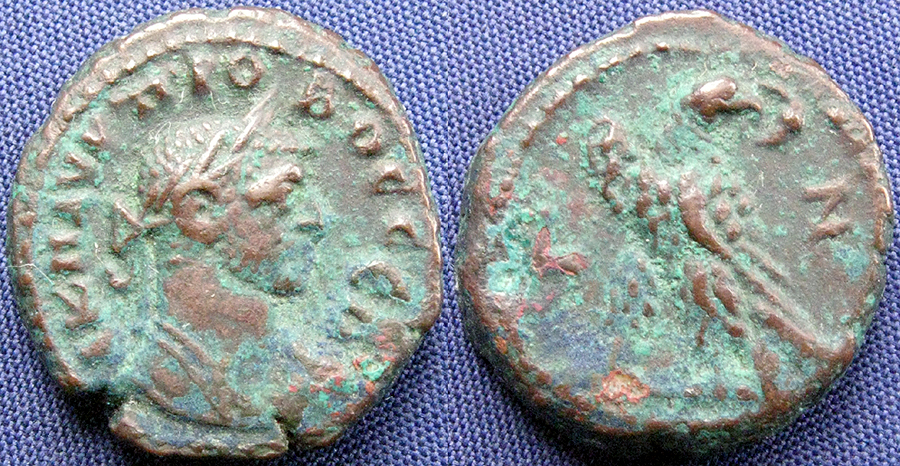
Roman Provincial, Egypt-Alexandria,
Tacitus, AE Tetradrachm, September 275-April 276 (Year 1)
AK KΛ · TAKI_TOC CEB
Laureate, draped, cuirassed bust right
ETOYC | A
Dikaiosyne (Aequitas) standing facing, head left, scales in right hand,
cornucopiae in left
20mm x 21mm, 8.08g
Emmett 3971 (1)
|
 |
Roman Provincial, Egypt-Alexandria,
Tacitus, AE Tetradrachm, September 275-April 276 (Year 1)
AK KΛ TAKI_TOC CEB
Laureate, draped, cuirassed bust right
ETOYC | A
Dikaiosyne (Aequitas) standing facing, head left, scales in right hand,
cornucopiae in left
19mm x 21mm, 7.06g
Emmett 3971 (1); Milne 4492
|
 |
Roman Provincial, Egypt-Alexandria,
Tacitus, AE Tetradrachm, September 275-April 276 (Year 1)
AK KΛ TAKI_TOC CEB
Laureate, draped, cuirassed bust right
ETOYC | A
Eagle standing left, head right, wreath in beak
19mm x 21mm, 6.72g
Emmett 3974 (1)
|
 |
Roman Provincial, Egypt-Alexandria,
Tacitus, AE Tetradrachm, September 275-April 276 (Year 1)
AK KΛ TAKI_TOC CEB
Laureate, draped, cuirassed bust right
ETOVC | A
Elpis standing facing, head left, flower upward in right hand, hitching
skirt with left
19mm x 21mm, 8.12g
Emmett 3975 (1)
|
| Probus:
276-282 |
 |
Roman Provincial, Egypt-Alexandria,
Probus, AE Tetradrachm, 276/277 (Year 2)
A K M AVP ΠPO_BOC CEB
Laureate, cuirassed bust right
(No legend)
Dikaiosyne (Aequitas) standing facing, head left, wearing chiton and
peplos, scales in right hand,
cornucopiae in left
L B in left field
19mm x 21mm, 7.57g
Emmett 3979; Köln 3127; Dattari 5527; BMC 2412; Milne 4521; Curtis 1846
|
 |
Roman Provincial, Egypt-Alexandria,
Probus, AE Tetradrachm, 278/279 (Year 4)
A K M AVP ΠP_OBOC CEB
Laureate, cuirassed bust right
(No legend)
Eagle standing right, wings closed, wreath in
beak, palm over left wing
L | Δ across fields
20mm, 7.26g
Emmett 3981; Köln 3135; Dattari 5563; BMC 2440; Milne 4587; Curtis 1855;
Demetrio 3320
Ex Jonathan Kern, 15 September 1975
|
 |
Roman Provincial, Egypt-Alexandria, Probus, AE Tetradrachm, 281/282 (Year 7)
A K M AVP ΠPOBOC CEB
Laureate, cuirassed bust right
(No legend)
Eagle standing right, wings spread, wreath in
beak
L | Z across fields
18mm x 20mm, 6.59g
Emmett 3982; Köln 3154; Dattari 5558; BMC 2436; Milne 4648; Curtis 1873;
Demetrio 3331
Ex Jonathan Kern, 14 July 1995
|
 |
Roman Provincial, Egypt-Alexandria,
Probus, AE Tetradrachm, 281/282 (Year 7)
A K M AVP ΠPOBOC CEB
Laureate, cuirassed bust right
(No legend)
Eagle standing right, wings spread, wreath in
beak
L | Z across fields
17mm x 20mm, 7.24g
Emmett 3982; Köln 3154; Dattari 5558; BMC 2436; Milne 4648; Curtis 1873;
Demetrio 3331
|
 |
Roman Provincial, Egypt-Alexandria,
Probus, AE Tetradrachm, 280/281 (Year 6)
A K M AVP ΠPO_BOC CEB
Laureate, cuirassed bust right
(No legend)
Eagle standing left, head right with wreath in
beak, wings closed
L | S across fields
18mm x 19mm, 6.65g
Emmett 3984; Köln 3150; Dattari 5554; BMC 2430; Milne 4629; Curtis 1863;
Demetrio 3330
|
 |
Roman Provincial, Egypt-Alexandria,
Probus, AE Tetradrachm, 281/282 (Year 7)
A K M AVP ΠPO_BOC CEB
Laureate, cuirassed bust right
(No legend)
Eagle standing left, head right with wreath in
beak, wings closed
L | Z across fields
18mm x 20mm, 7.26g
Emmett 3984 (1)
|
 |
Roman Provincial, Egypt-Alexandria, Probus, AE Tetradrachm, 278/279 (Year 4)
A K M AVP ΠPO_BOC CEB
Laureate, cuirassed bust right
(No legend)
Eagle standing facing, wings spread, head right, tail right, wreath in
beak
L | Δ across fields
19mm x 20mm, 8.51g
Emmett 3985 (1)
|
 |
Roman Provincial, Egypt-Alexandria,
Probus, AE Tetradrachm, 278/279 (Year 4)
A K M AVP ΠPOBOC CEB
Laureate, cuirassed bust right
(No legend)
Eagle standing facing, wings spread, head right, tail right, wreath in
beak
L | Δ across fields
19mm x 20mm, 6.99g
Emmett 3985 (1)
|
 |
Roman Provincial, Egypt-Alexandria,
Probus, AE Tetradrachm, 277/278 (Year 3)
A K M AVP ΠPO_BOC CEB
Laureate, cuirassed bust right
(No legend)
Eirene standing facing, head left, olive branch upward in right hand,
transverse scepter in left
L Γ in left field
19mm x 20mm, 8.43g
Emmett 3986 (1); Milne 4553
|
 |
Roman Provincial, Egypt-Alexandria,
Probus, AE Tetradrachm, 276/277 (Year 2)
A K M AUR PR_OBOC CEB
Laureate, cuirassed bust right
(No legend)
Elpis standing facing, head left, flower upward in right hand, holding
folds of skirt with left
L B in left field
20mm x 22mm, 7.22g
Emmett 3987 (1)
|
 |
Roman Provincial, Egypt-Alexandria,
Probus, AE Tetradrachm, 279/280 (Year 5)
A K M AUR PR_OBOC CEB
Laureate, cuirassed bust right
(No legend)
Nike advancing right, palm in left hand over shoulder, wreath upward in
right
L E in right field
18mm x 20mm, 6.39g
Emmett 3991 (1)
|
 |
Roman Provincial, Egypt-Alexandria,
Probus, AE Tetradrachm, 279/280 (Year 5)
A K M AVP ΠP_OBOC CEB
Laureate, cuirassed bust right
(No legend)
Nike advancing right, palm in left hand over shoulder, wreath upward in
right
E / L in right field
18mm x 19mm, 6.25g
Emmett 3991; Köln 3148; Dattari 5540; BMC 2421; Milne 4601; Curtis 1886;
Demetrio 3324
Ex Jonathan Kern, 14 July 1995
|
| Carus:
282-284 |
 |
Roman Provincial, Egypt-Alexandria, Carus, AE Tetradrachm, 282/283 (Year 1)
A K MA KA_POC CEB
Laureate, draped, cuirassed bust right
(No legend)
Dikaiosyne standing facing, head left, scales in right hand, cornucopiae
in left
L A in left field
19mm x 20mm, 7.49g
Emmett 3996 (1)
Ex Bill Kalmbach
|
 |
Roman Provincial, Egypt-Alexandria,
Carus, AE Tetradrachm, 282/283 (Year 1)
A K MA KA_POC CEB
Laureate, draped, cuirassed bust right
(No legend)
Dikaiosyne standing facing, head left, scales in right hand, cornucopiae
in left
L A in left field
19mm x 20mm, 6.24g
Emmett 3996 (1); Milne 4660
|
| Carinus:
282-284 |
 |
Roman Provincial, Egypt-Alexandria,
Carinus, AE Tetradrachm, 283/284 (Year 2)
A K MA KA_RINOC CEB
Laureate, cuirassed bust right
(No legend)
Eagle standing left, head right, wreath in beak, wings open, between two
vexilla
L B / * in upper field
18mm x 20mm, 9.29g
Emmett 4005 (2)
Ex Bill Kalmbach
|
 |
Roman Provincial, Egypt-Alexandria,
Carinus, AE Tetradrachm, 283/284 (Year 2)
A K MA KA_PINOC CEB
Laureate, cuirassed bust right
(No legend)
Eagle standing left, head right, wreath in beak, wings open, between two
vexilla
L B in upper field
18mm x 19mm, 7.05g
Emmett 4005; Köln 3174; Dattari 5596; BMC --; Milne 4710; Curtis --;
Demetrio 3356
|
 |
Roman Provincial, Egypt-Alexandria, Carinus, AE Tetradrachm, 283/284 (Year 2)
A K MA KA_PINOC CEB
Laureate, cuirassed bust right
(No legend)
Eagle standing left, head right, wreath in beak, wings open, between two
vexilla
L B in upper field
18mm x 19mm, 6.89g
Emmett 4005; Köln 3174; Dattari 5596; BMC --; Milne 4710; Curtis --;
Demetrio 3356
|
 |
Roman Provincial, Egypt-Alexandria,
Carinus, AE Tetradrachm, 283/284 (Year 2)
A K MA KA_PINOC CEB
Laureate, cuirassed bust right
(No legend)
Eagle standing left, head right, wreath in beak, wings open, between two
vexilla
L B in upper field
19mm x 22mm, 7.81g
Emmett 4005; Köln 3174; Dattari 5596; BMC --; Milne 4710; Curtis --;
Demetrio 3356
|
 |
Roman Provincial, Egypt-Alexandria,
Carinus, AE Tetradrachm, 283/284 (Year 2)
A K MA KA_PINOC CEB
Laureate, cuirassed bust right
(No legend)
Eagle standing left, head right, wreath in beak, wings open, between two
vexilla
L B in upper field
18mm x 19mm, 8.40g
Emmett 4005; Köln 3174; Dattari 5596; BMC --; Milne 4710; Curtis --;
Demetrio 3356
|
 |
Roman Provincial, Egypt-Alexandria,
Carinus, AE Tetradrachm, 283/284 (Year 2)
A K MA KA_PINOC CEB
Laureate, cuirassed bust right
(No legend)
Elpis standing left, wearing chiton and peplos, flower upward in right
hand, hitching skirt with left
L | B across fields
18mm x 19mm, 7.31g
Emmett 4007; Köln 3177/3178; Dattari 5584; BMC 2454; Milne 4701; Curtis 1917;
Demetrio 3352
|
 |
Roman Provincial, Egypt-Alexandria,
Carinus, AE Tetradrachm, 283/284 (Year 2)
A K MA KA_PINOC CEB
Laureate, cuirassed bust right
(No legend)
Elpis standing left, wearing chiton and peplos, flower upward in right
hand, hitching skirt with left
L | B across fields
18mm x 19mm, 6.38g
Emmett 4007; Köln 3177-3179; Dattari 5584; BMC 2454; Milne 4701; Curtis 1917;
Demetrio 3352; Vogt II 166
Ex Martin J. Deenan, Boston, 14 February 1995
|
 |
Roman Provincial, Egypt-Alexandria,
Carinus, AE Tetradrachm, 283/284 (Year 2)
A K MA KA_PINOC CEB
Laureate, cuirassed bust right
(No legend)
Elpis standing left, wearing chiton and peplos, flower upward in right
hand, hitching skirt with left
L | * / B across fields
19mm, 7.74g
Emmett 4007; Köln 3180; Dattari 5585; BMC 2453; Milne 4721; Curtis 1919;
Demetrio 3353
|
 |
Roman Provincial, Egypt-Alexandria,
Carinus, AE Tetradrachm, 283/284 (Year 2)
A K MA KA_PINOC CEB
Laureate, cuirassed bust right
(No legend)
Elpis standing left, wearing chiton and peplos, flower upward in right
hand, hitching skirt with left
L | * / B across fields
18mm x 19mm, 8.40g
Emmett 4007; Köln 3180; Dattari 5585; BMC 2453; Milne 4721; Curtis 1919;
Demetrio 3353
Ex Fred Shore, 8 February 1996
|
 |
Roman Provincial, Egypt-Alexandria,
Carinus, AE Tetradrachm, 284/285 (Year 3)
A K MA KA_PINOC CEB
Laureate, cuirassed bust right
ETOVC
Nike advancing right, wearing chiton and peplos, palm in left hand over
shoulder, wreath upward in right
Γ in right field
17mm x 18mm, 5.86g
Emmett 4010; Köln 3186; Dattari 5590; BMC 2457; Milne 4738; Curtis 1926;
Demetrio 3357
|
| Numerian:
(as Caesar) 282-283, (as Augustus) 283-284 |
 |
Roman Provincial, Egypt-Alexandria, Numerian as Augustus, AE Tetradrachm, 283/284 (Year
2)
A K MA NOVMAPIANOC CEB
Laureate, draped bust right, seen from behind
(No legend)
Eagle standing left, head right, wreath in beak, wings open, between two
vexilla
L B in upper field
19mm x 21mm, 8.41g
Emmett 4018 (2)
|
| Diocletian:
284-296 |
 |
Roman Provincial, Egypt-Alexandria,
Diocletian, AE Tetradrachm, 285/286 (Year 2)
AK ΓOY AΛ ΔIOKΛHTIANOC CEB
Laureate, cuirassed bust right
(No legend)
Alexandria standing facing, turreted head left, long vertical scepter in
left hand, Head of Serapis wearing modius in right
L | B across fields
20mm x 21mm, 7.34g
Emmett 4025; Köln 3210; Dattari 5622; BMC 2529; Milne 4781; Curtis 1954;
Demetrio 3373
Ex Empire Coins, 19 August 1995
|
 |
Roman Provincial, Egypt-Alexandria,
Diocletian, AE Tetradrachm, 285/286 (Year 2)
AK ΓOY AΛ ΔIOKΛHTIANOC CEB
Laureate, cuirassed bust right
(No legend)
Alexandria standing facing, turreted head left, long vertical scepter in
left hand, Head of Serapis wearing modius in right
L | B across fields
17mm x 21mm, 6.11g
Emmett 4025; Köln 3210; Dattari 5622; BMC 2529; Milne 4781; Curtis 1954;
Demetrio 3373
|
 |
Roman Provincial, Egypt-Alexandria, Diocletian, AE Tetradrachm, 291/292 (Year 8)
DIOKLHTI_ANOC CEB
Laureate head right
(No legend)
Athena seated left on shield, vertical spear in left hand, Nike in right
L | H across fields
20mm x 21mm, 8.07g
Emmett 4032 (1)
|
 |
Roman Provincial, Egypt-Alexandria,
Diocletian, AE Tetradrachm, 285/286 (Year 2)
AK ΓOY AΛ ΔIOKΛHTIANOC CEB
Laureate, cuirassed bust right
(No legend)
Eirene standing facing, head left, wearing chiton and peplos, long
transverse scepter in left hand, olive branch upward in right
L | B across fields
20mm x 21mm, 6.86g
Emmett 4045; Köln 3217; Dattari 5654; BMC 2493; Milne 4774; Curtis 1976;
Demetrio 3372
|
 |
Roman Provincial, Egypt-Alexandria,
Diocletian, AE Tetradrachm, 284/285 (Year 1)
A K ΓO VAΛ ΔIOKΛHTIANOC CEB
Laureate, cuirassed bust right
(No legend)
Elpis standing left, flower upward in right hand, hitching chiton skirt with left
L A in left field
19mm x 20mm, 7.31g
Emmett 4046; BMC 2503
|
 |
Roman Provincial, Egypt-Alexandria,
Diocletian, AE Tetradrachm, 292/293 (Year 9), Officina 4
ΔIOKΛHTIANOC CEB
Laureate, cuirassed bust right
ENATOV
Elpis standing left, flower upward in right hand, hitching chiton skirt with left
L in right field
Δ in exergue
18mm x 19mm, 6.74g
Emmett 4046; Köln 3262; Dattari 5675; BMC 2503; Milne 5086; Curtis 1990;
Demetrio 3411
Ex Empire Coins, Auction 7, 2 May 1987; Ex Gordon Dickie Collection
|
 |
Roman Provincial, Egypt-Alexandria,
Diocletian, AE Tetradrachm, 292/293 (Year 9), Officina 4
ΔIOKΛHTIANOC CEB
Laureate, cuirassed bust right
ENATOV
Elpis standing left, flower upward in right hand, hitching chiton skirt with left
L in right field
Δ in exergue
19mm x 20mm, 8.02g
Emmett 4046 (1); Köln 3262; Dattari 5675; BMC 2503; Milne 5086; Curtis 1990;
Demetrio 3411
|
 |
Roman Provincial, Egypt-Alexandria,
Diocletian, AE Tetradrachm, 287/288 (Year 4)
A K ΓO VA ΔIOKΛHTIANOC CEB
Laureate head right
(No legend)
Nike advancing right, wreath upward in right hand, palm over shoulder in left
L | * / Δ across fields
17mm x 18mm, 7.45g
Emmett 4066 (3); Dattari 5729; Milne 4878
|
 |
Roman Provincial, Egypt-Alexandria,
Diocletian, AE Tetradrachm, 291/292 (Year 8), Officina 1
DIOKLHTIANOC CEB
Laureate, cuirassed bust right
(No legend)
Nike standing facing, head right, wings spread, wreath upward in right
hand, palm in left
L | H across fields
A in exergue
18mm, 6.66g
Emmett 4069 (4)
Ex Sphinx Numismatics, VCoins, March 2008
Note: Officina marks were only used during years 8-10 of Diocletian, 7-9 of Maximianus and 1-2 of Galerius and Constantius I.
Emmett, on p.xvii, proposed Die Carver 1 for officina A (Diocletian, Constantius I) and officina B
(Maximianus, Galerius)
and Die Carver 2 for officina G and * (Maximianus,
Galerius) and officina
D (Diocletian, Constantius I)
|
 |
Roman Provincial, Egypt-Alexandria,
Diocletian, AE Tetradrachm, 284/285 (Year 1)
AK GOU AL DIOKLHTIANOC
CEB
Laureate, cuirassed bust right
(No legend)
Tyche reclining left on lectistern, leaning on left hand
L A in upper field
19mm x 21mm, 7.92g
Emmett 4083 (1)
Some interesting follow-up notes from Tom Barbeau on September 26, 2006 with a reattribution of the reverse scene from Emmett's description
of Tyche reclining on ship with rudder: "The couch apparently may be referred to as lectistern. The gods were invited to a feast of
reconciliation at times of upheaval and calamity. The feast was called a lectisternium. There are a number of reverse types which
commemorate lectisternia. In the case of Diocletian, the upheaval commemorated here in year 1 was no doubt his accession to power over the
Carian dynasty; probably a huge deal in Alexandria."
|
 |
Roman Provincial, Egypt-Alexandria, Diocletian, AE Tetradrachm, 290/291 (Year
7)
ΔIOKΛHTI_ANOC CEB
Laureate head right
(No legend)
Zeus standing facing, head left, nude but for chlamys over shoulder,
patera in right hand, long vertical scepter in left, eagle at feet to
left, standing left, head right
L | Z across fields
20mm x 21mm, 7.87g
Emmett 4087 (1); Milne 4946
|
| Maximianus:
285-296 |
 |
Roman Provincial, Egypt-Alexandria,
Maximianus, AE Tetradrachm, 285/286 (Year 1)
A K M OVA MAΞIMIANOC CEB
Laureate, draped bust right
(No legend)
Alexandria standing left, head of Serapis in right hand, long vertical
scepter in left
L | A across fields
19mm x 20mm, 6.74g
Emmett 4093 (2); Milne 4785
|
 |
Roman Provincial, Egypt-Alexandria, Maximianus, AE Tetradrachm, 289/290 (Year 5)
A K MA OVA MAΞIMIANOC CEB
Laureate head right
(No legend)
Dikaiosyne standing facing, head left, wearing chiton and peplos, scales in right hand, cornucopiae
in left
E / L in left field
18mm x 19mm, 7.26g
Emmett 4103; Köln 3305/3306; Dattari 5849; BMC 2550; Milne 4922; Curtis 2057;
Demetrio 3450; Vogt II 170
Ex Alex Malloy, 21 April 1998; Ex William Turner Collection, 1812-1817
|
 |
Roman Provincial, Egypt-Alexandria,
Maximianus, AE Tetradrachm, 287/288 (Year 3)
A K M OVA MAΞIMIANOC CEB
Laureate head right, draped, cuirassed bust right, seen from behind
(No legend)
Eusebeia standing left, box of perfumes in left hand, sprinkling incense
from right hand over altar at left
* / L | Γ across fields
17mm x 18mm, 6.58g
Emmett 4123 (3); Dattari 5893
|
 |
Roman Provincial, Egypt-Alexandria,
Maximianus, AE Tetradrachm, 291/292 (Year 7), Officina 2
MAΞIMIANOC CEB
Laureate head right
(No legend)
Hercules standing facing, head left, leaning on club with right hand,
apples in left hand, lion's skin over left arm
L | Z across fields
B in exergue
19mm x 20mm, 7.61g
Emmett 4131 (3)
Ex Ancient Resource, VCoins, February 2006
Note: Officina marks were only used during years 8-10 of Diocletian, 7-9 of Maximianus and 1-2 of Galerius and Constantius I.
Emmett, on p.xvii, proposed Die Carver 1 for officina A (Diocletian, Constantius I) and officina B (Maximianus, Galerius)
and Die Carver 2 for officina G and * (Maximianus, Galerius) and officina
D (Diocletian, Constantius I)
|
 |
Roman Provincial, Egypt-Alexandria,
Maximianus, AE Tetradrachm, 287/288 (Year 3)
AK MA OVA MAΞIMIANOC CEB
Laureate, draped bust right, seen from behind
(No legend)
Homonoia standing facing, head left, right hand raised, double cornucopiae
in left
L | * / Γ across fields
20mm x 22mm, 6.18g
Emmett 4141 (1); Milne 4855; Curtis 2091; BMC 2563
|
|

|
Roman Provincial, Egypt-Alexandria, Maximianus, AE Tetradrachm, 287/288 (Year 3)
A K M OVA MAΞIMIANOC CEB
Laureate, draped, cuirassed bust right, seen from behind
(No legend)
Nike advancing right, palm in left hand over shoulder, wreath upward in
right
L | * / Γ across fields
19mm x 21mm, 7.71g
Emmett 4147 (1)
|
|

|
Roman Provincial, Egypt-Alexandria,
Maximianus, AE Tetradrachm, 291/292 (Year 7)
MAΞIMIANOC CEB
Laureate, draped, cuirassed bust right, seen from behind
(No legend)
Nike advancing right, palm in left hand over shoulder, wreath upward in
right
L | Z across fields
20mm x 21mm, 8.25g
Emmett 4147 (1)
|
|

|
Roman Provincial, Egypt-Alexandria,
Maximianus, AE Tetradrachm, 291/292 (Year 7)
MAΞIMIANOC CEB
Laureate, draped, cuirassed bust right, seen from behind
(No legend)
Nike advancing right, wearing chiton and peplos, palm in left hand over shoulder, wreath upward in
right
L | * / Z across fields
20mm x 21mm, 8.25g
Emmett 4147; Köln 3319; Dattari 5967 var; BMC 2580 var; Milne 5032; Curtis 2101;
Demetrio --
Ex Jonathan K. Kern, 5 November 2002
|
|

|
Roman Provincial, Egypt-Alexandria,
Maximianus, AE Tetradrachm, 290/291 (Year 6)
MAΞIMIANOC CEB
Laureate, draped, cuirassed bust right, seen from behind
(No legend)
Nike advancing left, palm in left hand over shoulder, wreath upward in
right
L V | * across fields
20mm, 8.69g
Emmett 4148 variant (1 for type)
Note: Emmett does not mention a star in the field on this issue. Also, this example has gorgeous, toned silvered surfaces, rarely found on
potin tetradrachms.
|
| Constantius
I: 292-296 |
 |
Roman Provincial, Egypt-Alexandria,
Constantius I, AE Tetradrachm, 293/294 (Year 2)
FL KWCTANTIOC K
Laureate, draped, cuirassed bust right
(No legend)
Elpis standing left, flower upward in right hand, hitching skirt with left
L | B across fields
18mm x 19mm, 8.30g
Emmett 4185 (1)
|
|
Anonymous Issue under Caligula |
 |
Roman Provincial, Egypt-Alexandria, Anonymous Issue under Caligula, AE Hemiobol, 36/37 (Year
2)
(No legend)
Heron standing left
(No legend)
Apis bull standing right
L B above
14mm x 15mm, 2.02g
Emmett 4257 (1)
Ex Keith Emmett Collection, December 2007; Ex Bill Kalmbach
Collection, January 2000
|
| Anonymous
Lead Tokens |
 |
Roman Provincial, Egypt-Alexandria,
Anonymous Issues, Lead Token, c.1st-3rd Century AD, Year 12
(No legend)
Nilus reclining left
(No legend)
Euthenia reclining left
L IB in exergue
18mm x 19mm, 3.60g
Emmett 4325 (5)
|
| Uncertain
Issues |
 |
Roman Provincial, Egypt-Alexandria, Uncertain Issuer, AE Chalkon (Year 4)
(No legend)
Bare (?) head right, damnatio or countermark (?) across portrait
(No legend)
Grain ear bundle
L | D across fields
11mm x 12mm, 0.60g
Emmett ? (?)
Ex Keith Emmett Collection, December 2007
Note: Emmett relayed in private correspondence that he believes the bundle
may be in a vase, which would be a new type.
|
 |
Roman Provincial, Egypt-Alexandria, Uncertain Issuer, AE Chalkon (Year 3)
(No legend)
Laureate head right
(No legend)
Elpis standing facing, head left, flower upward in right hand, hitching
skirt with left
L | G across fields
10mm x 11mm, 0.47g
Emmett ? (?)
Ex Keith Emmett Collection, December 2007
|
|