|
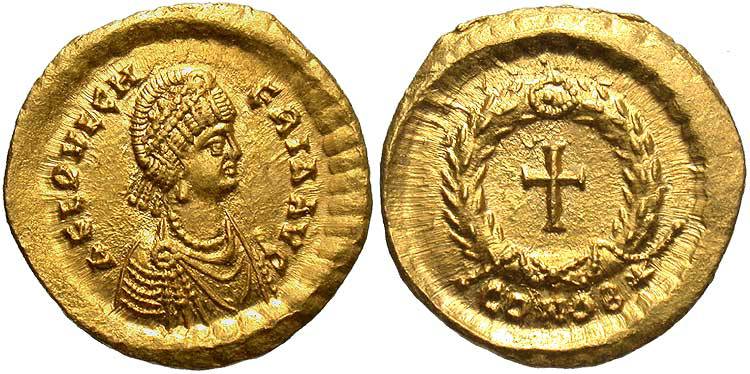
Aelia Pulcheria, AV Tremissis, August 24, 450-July 453, Constantinople
AEL PVLCH_ERIA AVG
Pearl-diademed, draped bust right with necklace and earrings, hair
elaborately weaved with long plait up the back of head and tucked under
diadem
(No legend)
Cross within laurel wreath terminating in large jewel, wreath tie type 14
CONOB* in exergue
14mm, 1.48g
RIC X, 521 (Marcian) (R3)
Ex Tkalec Auction, February 2000, Lot 495
Notes from David Sear CoA on April 18, 2007:
Aelia Pulcheria was born in 399, the daughter of the Emperor Arcadius
(383-408) and Aelia Eudoxia, daughter of Bauto the Frank. Her
strong-minded mother died when Pulcheria was only five, but she must have
learned a good deal from her as she was to be a powerful influence in the
politics of the Eastern Empire for four decades. Her weak younger brother,
Theodosius II, only son of Arcadius, ascended the throne on their father's
death in 408. Initially, power was in the hands of the praetorian prefect
and patrician, Anthemius, but on July 4, 414, the 15-year-old Pulcheria
was proclaimed Augusta and assumed control of the government. She was to
retain this role throughout her brother's long reign (408-450) and by
taking vows of celibacy, together with her sisters Arcadia and Marina, she
insured that Theodosius' throne would not be threatened by an ambitious
brother-in-law. Her authority was challenged at various times, primarily
by Theodosius' wife, Eudocia-Athenais (married in 422) prior to her
retirement to Jerusalem in 422/423. Following Theodosius' sudden and
unexpected death, resulting from a hunting accident in 450, Pulcheria gave
her blessing to the selection of the popular soldier Marcian to ascend the
vacant Eastern throne. They went through a nominal marriage ceremony to
legitimize the succession and the following year Pulcheria was
instrumental in summoning the Fourth Ecumenical Council at Chalcedon,
which established the basic principles of teaching the Eastern Orthodox
Church. She died honored and lamented in 453 and left all her possessions
to the poor.
The coinage of Pulcheria closely mirrors that of her brother and she
may, indeed, have been responsible for the introduction in 422 of the
prominent jeweled cross on the 'Victory holding cross' solidus type, and
for the Christianization of the globe held by the seated Constantinopolis
on the later coinage. The gold tremissis denomination, worth one-third
solidus, became increasingly important during the 5th century and was
struck in considerable numbers under Theodosius II and his successors.
The ties of the wreath on the reverse [of this example] would appear to
date this variety to the closing years of Pulcheria's life and it may well
have been struck early in the reign of Marcian rather than under
Theodosius II. The letters "OB" in the mint mark represent an
official guarantee of the metal (obryzum = pure gold).
|