|
| | Midwest Collection of Coins of
Christianity
Collection assembled by a Midwest collector, cataloguing the symbology across
various cultures, associated with Christianity.
|
Ptolemaic Kingdom |
 |
Ptolemaic
Kingdom,
Ptolemy VIII Euergetes, AE25, 145-116 BC, Alexandria Mint
(No legend)
Diademed, horned head of Zeus Ammon
ΠTOΛEMAIOY-BAΣIΛEΩΣ
Eagle standing left on thunderbolt, wings open
Regnal date (unclear) over lotus in left field
25mm x 27mm, 9.63g
Svoronos 1622; Sear GCV II, 7919
Ex Midwest "Coins of Christianity" Collection
Consignor notes: The object in the left field appears to be a cross, not a
lotus.
|
|
Thracian Kingdom |
 |
Thracian Kingdom, Lysimachos (305-281 BC), AE13, Countermark c.150 BC
(No legend)
Head of Herakles right in lion-skin headdress
BAΣI / ΛYΣI
Legend in grain wreath, nearly obliterated by cross countermark
13mm x 14mm, 2.94g
Müller 14; SNG Copenhagen 1168; Sear GCV II, 6822
Ex Midwest "Coins of Christianity" Collection
Consignor notes: Thrace was one of the earliest destinations for the
Diaspora. It was a region roughly occupying modern-day northern Greece,
northern Turkey and southern Bulgaria. The largest city was Byzantium,
modern-day Istanbul. Thrace was also home to Philippi, one of the earliest
Christian churches established by Paul.
|
|
Armenian Kingdom |
 |
Armenian Kingdom, Tigranes II (95-56 BC), AR Tetradrachm, Antioch
Mint
(No legend)
Bust of Tigranes right, wearing an Armenian tiara with five
pyramidal points and adorned with a comet star between two eagles, in
border of reeds
BAΣIΛEΩ_Σ | TIΓPANOY
Tyche of Antioch seated right on rocks, vertical palm in
right hand, river-god Orontes swimming right below and looking back, all within laurel wreath
Monogram in right field, Tau-Rho symbol on rocks
25mm x 27mm, 15.03g
Depeyrot, Armenien 29; Bedoukian 20
Ex Midwest "Coins of Christianity" Collection; Ex Monnaies d'Antan, 2008
Notes and commentary from consignor:
Based on the overall style and monogram combinations, this coin was minted
between 83-70 BC.
Tigranes was one of the most successful rulers of his time, a capable
military leader, and skilled at negotiating treaties and providing sound
economic directions. His territory included present-day Syria, Lebanon,
Turkey, Jordan, Armenia and parts of southern Russia. He defeated armies
of the Parthians, Syrians and Seleukids. Tigranes was eventually defeated
by the Roman general Lucullus in 66 BC, but was able to negotiate his continued reign in Armenia.
There are many historical records of Judeans and
Samaritans being deported to Armenia and as a large part of the Diaspora.
Tigranes was also successful in getting many Samaritans to voluntarily
come to Armenia, where they established a successful commercial center in
the town of Vartkesavan. This wealth of Samaritan tradition appears to
have played a big role in the use of Messianic symbols on coins.
The tau-rho monogram represents the suffering Messiah
and was eventually used by Christian writers as a nomina sacro in ancient
scriptures. This symbol is now better known (incorrectly) as the Christogram and this is
the earliest use of the tau-rho (properly Staurogram) monogram I have found. The
tau-rho has been incorrectly compared to the chi-rho for a long time. They
are distinctly different symbols with the chi-rho being Greek shorthand
for "Christ" and the tau-rho being shorthand for stauros
or "cross" in Greek.
|
|
Seleukid Kingdom |
 |
Seleukid Kingdom, Alexander II, Zabinas (128-122 BC), AE18 Serratus,
Antioch on the Orontes
(No legend)
Head of young Dionysos right, wearing ivy wreath
BAΣIΛEΩΣ | AΛEΞANΔPOY
Tyche standing left, rudder in right hand, cornucopiae in left
Monogram over cross with rays in left field
17mm x 19mm, 6.81g
Sear GCV II, 7133; Newell 1015
Ex Midwest "Coins of Christianity" Collection
Consignor notes: The cross in the field was likely used because of the
large population of the Diaspora throughout the lands of the Seleukid
Kingdom and symbolized the anticipation of the coming Yeshua HaMasiach.
|
|
Tetrarchs of Chalkis |
 |
Tetrarchs of Chalkis, Lysanias (40-36 BC), AE18, c.40 BC, Damascus
(No legend)
Bust of Artemis right, bow over shoulder
(Various monograms)
Crossed cornucopiae, decorated with hanging diadems, flanking star and
crescent
17mm x 19mm, 2.30g
RPC I, 4769
Ex Midwest "Coins of Christianity" Collection
Consignor notes: This coin was minted during the short reign of Lysanias, the son
of Ptolemy Menneus and cousin of Mattathias Antigonas. Lysanis was executed by
Marc Antony in 36BC. His cousin, Mattathias, was both King and High Priest
of the Jews from 40-37BC, leading many Jews to think he was the Messiah
because he held both titles and was crucified by the Romans.
Chalkis was a small nation that included Damascus and was home to many
Jews and Samaritans. The symbolism on this coin incorporates the Divinity
of the coming Messiah. The crescent and star is the "Star out of
Jacob", the cornucopiae represent the hope of the people and the
diadems Divinity.
|
|
Bactrian and Indo-Scythian Kingdoms |
 |
Bactrian and Indo-Scythian Kingdoms, Apollodotos II (80-65 BC), AR Drachm, c.65 BC, Uncertain
Bactrian Mint - Probably Taxila or Punjab
BAΣIΛEΩΣ ΣΩTHPOΣ KAI ΦIΛOΠATOPOΣ / AΠOΛΛOΔOTOY
Diademed, draped bust right
Kharoshthi script (Maharajasa tratarasa / Apaladatasa)
Athena Alkidemos standing left, wearing aegis, seen from behind, shield on
outstretched left arm, hurling thunderbolt with right hand
Tau-rho monogram in left field
16mm x 17mm, 2.38g
Ex Midwest "Coins of Christianity" Collection
Notes and commentary from consignor:
Bactria was a part of the northeastern periphery of the Persian Empire. It
consisted of parts of modern-day Afghanistan, Tajikistan, Uzbekistan and
Turkmenistan. The region was host to religions like Zoroastrianism and
Buddhism. It also had a large contingent of the Judean and Samaritan
Diaspora. As with many other examples of the tau-rho monogram, this use is
associated with the locations of the tribes of the Northern Kingdom -
especially the Samaritans.
Athena Alkidemos has an interesting meaning. She was a goddess of
Macedonian origin that was the "protector of the people". The
use of the tau-rho, with its underlying meaning for the Messiah, may be
related to its use with Alkidemos.
|
 |
Bactrian and Indo-Scythian Kingdoms, Zoilos II (c.55-35 BC), AR Drachm, c.35
BC, Taxila or Punjab Mint
BAΣIΛEΩΣ ΣΩTHPOY / ZΩIΛOY
Diademed, draped bust of Zoilos II right
Kharosthi legend (Maharajasa tratarasa Jhoilasa)
Athena Alkidemos standing left, wearing aegis, seen from behind, shield on
outstretched left arm, hurling thunderbolt with right hand
Monograms and tau-rho in fields
15mm x 16mm, 2.13g
Ex Midwest
"Coins of Christianity" Collection
Notes and commentary from consignor:
Zoilos II reigned c.55 to 35 BC in the area of modern-day northern
Pakistan, northern India and southern Afghanistan. In ancient times, this
area was moderately populated by the Jewish Diaspora, particularly the
tribe of Manasseh.
The staurogram (tau-rho) symbol was used primarily by the Diaspora from
the northern kingdom, who settled mainly east and north of Israel.
Kingdoms such as Samaria, Chalkis, Armenia, Parthia and Scythia appear to
use this symbol for the anticipated coming of the Messiah.
|
 |
Bactrian and Indo-Scythian Kingdoms,
Azes II (c.35-12 BC), AR Drachm, c.12 BC, Hazara Mint
BAΣIΛEΩΣ BAΣIΛEΩN MEΓAΛOY / AZOY
Azes II, in military dress, whip upward in right hand, advancing right on
horseback, symbol in right field
Kharosthi legend (Maharajasa Rajarajasa mahatasa Ayasa)
Pallas standing facing in military dress, right hand raised, shield in
left, transverse spear behind
Staurogram | monogram across fields
16mm, 2.16g
Senior 96.2
Ex
Midwest "Coins of Christianity" Collection
Notes and commentary from consignor:
The regnal dates of Azes II are greatly disputed, but the most likely
period is 35-12 BC (although, this precludes him from being one of the
Wise Men from the Christian legend).
The Indo-Scythian kingdom included most of modern-day northern India. This
region had a large population of the Samaritan Diaspora, so the knowledge
of the coming Messiah would have been widespread. This is the same region
in which Gondophares was converted to Christianity by the Apostle Thomas
in 50 AD.
This coin shows a styled Staurogram (tau-rho) with one of the crossbars
including a spike. This could represent piercings of the suffering
Messiah.
|
 |
Bactrian and Indo-Scythian Kingdoms,
Azes II (c.35-12 BC), AE Pentachalkon, c.12 BC, Taxila
BAΣIΛEΩΣ BAΣIΛEΩN MEΓAΛOY / AZOY
City goddess enthrones left, monogram in box behind
Kharosthi legend (Maharajasa Rajarajasa mahatasa Ayasa)
Hermes standing facing, head left, right hand raised, kerykeion in left,
Staurogram in left field
26mm x 27mm, 11.98g
MACW 2321
Ex Midwest "Coins of
Christianity" Collection
|
 |
Bactrian and Indo-Scythian Kingdoms,
Azes II (c.35-12 BC), AE Hexachalkon, c.12 BC, Taxila
BAΣIΛEΩΣ BAΣIΛEΩN MEΓAΛOY / AZOY
Humped bull standing right, monogram in box above
Kharosthi legend (Maharajasa Rajarajasa mahatasa Ayasa)
Lion standing right, Staurogram above
25mm x 29mm, 14.63g
MACW 2383
Ex Midwest "Coins of Christianity"
Collection
|
 |
Bactrian and Indo-Scythian Kingdoms, Gondophares-Sases, AE Tetradrachm, c.19-46 AD,
Taxila
(Corrupted Greek legend)
Gondophares-Sases, in military dress, whip upward in right hand, advancing right on
horseback, symbol in right field, cross under horse
Kharosthi legend
Zeus standing right, long scepter in left hand, various symbols in fields
21mm x 22mm, 9.02g
Senior, Indo-Scythian, 242.641T; Mitchener,
Indo-Greek, 1138d (Sasan)
Ex Midwest "Coins of Christianity"
Collection
Consignor notes: Christianity came to ancient India c.40 AD when the
Apostle Thomas arrived in the Tamil region and established seven churches.
He baptized King Gondophares, making Christianity "official".
Unfortunately, there was great turmoil in India between the religious and
regional factions. The Brahmans were the majority and methodically
persecuted the Buddhists and Christian. As a result, Thomas was martyred
by the Brahmans c.60 AD.
|
|
Parthian Kingdom |
 |
Parthian Kingdom, Phraates III (70-57 BC), AR Drachm, c.60 BC, Rhagae Mint
(No legend)
Long-bearded bust left wearing tiara (T39ii) decorated on side with horn
and stags with prominent antlers around crest; circular border of pellets
BAΣIΛEΩΣ / MEΓAΛOY | APΣA_KOY | EYEPΓETOY |
EΠIΦANOYΣ / KAI ΦIΛEΛΛHNOΣ
Beardless archer wearing bashlyk and cloak,
seated right on throne, bow in right hand
Tau-rho in right field
19mm x 21mm, 4.07g
Sellwood 39.4, Shore 181
Ex Midwest "Coins of Christianity" Collection
Consignor notes and comments:
Parthia was home to a large population of the Diaspora, including
Samaritans. The customs, history and prophecies of the Samaritans were
shared with the religious leaders in Parthia. The main religion of Parthia
was Zoroastrianism and Zoroastrian priests were most likely the "Wise
Men" of the nativity story. These "wise men" were aware of
the prophesied suffering Messiah, as shown by the tau-rho monograms on
their coins and the discovery of the Star of Bethlehem.
|
 |
Parthian Kingdom, Orodes II (57-38 BC), AR Drachm, c.40 BC, Susa Mint
(No legend)
Short-bearded, diademed, bust left, wearing pellet-ended torque, star
before and crescent behind, no wart visible on forehead, circular border
of pellets
BAΣIΛEΩΣ /
BAΣIΛEΩN | AP_ΣAKOY | EYEPΓETOY / ΔIKAIOY | EΠIΦANOYΣ /
ΦIΛEΛΛHNOΣ
Beardless archer wearing bashlyk and cloak, seated right on throne, bow in
right hand
ΠA monogram / tau-rho in right field
19mm x 20mm, 3.05g
Sellwood 47.22
Ex Midwest "Coins of Christianity" Collection
|
 |
Parthian Kingdom, Orodes II (57-38 BC), AR Drachm, c.40 BC, Susa Mint
(No legend)
Short-bearded, diademed, bust left, wearing pellet-ended torque, star
before and crescent behind, no wart visible on forehead, circular border
of pellets
BAΣIΛEΩΣ /
BAΣIΛEΩN | AP_ΣAKOY | EYEPΓETOY / ΔIKAIOY |
EΠIΦANOYΣ /
ΦIΛEΛΛHNOΣ
Beardless archer wearing bashlyk and cloak, seated right on throne, bow in
right hand
ΘE monogram / tau-rho in right field
18mm x 19mm, 3.13g
Sellwood 47.24 variant (ΘE above bow)
Ex Midwest "Coins of Christianity" Collection
|
 |
Parthian Kingdom, Orodes II (57-38 BC), AR Drachm, c.38 BC, Mithradatkart Mint
(No legend)
Short-bearded, diademed, bust left, wearing pellet-ended torque, beaded
tunic with Messianic cross on shoulder, star
before and crescent behind, no wart visible on forehead, circular border
of pellets
BAΣIΛEΩΣ /
BAΣIΛEΩN | AP_ΣAKOY | EYEPΓETOY / ΔIKAIOY |
EΠIΦANOYΣ /
ΦIΛEΛΛHNOΣ
Beardless archer wearing bashlyk and cloak, seated right on throne, bow in
right hand, monogram below
19mm x 20mm, 2.91g
Sellwood 47.9 variant ( tunic)
Ex Midwest "Coins of Christianity" Collection
Notes: During the Tannaic Period, Parthia is known as Babylon in the
Talmud. Orodes II challenged Roman power and installed Mattathias
Antigonus as the last king of Judaea in Jerusalem.
|
 |
Parthian Kingdom, Gotarzes II (40-51), AR Drachm,
Ecbatana Mint
(No legend)
Bare-headed bust left with medium to long, square cut beard,
diadem with loop at the top and three ends, border of dots
Corrupted form of BAΣIΛEΩΣ BAΣIΛEΩN / APΣAKOY / EYEPΓETOY ΔIKAIOY / EΠIΦANOYΣ
ΦIΛEΛΛHNOΣ
Archer seated right on throne, holding bow over monogram, cross below
throne
18mm x 21mm, 3.09g
Sellwood 65.33; Shore 364
Ex Midwest "Coins of Christianity"
Collection
|
 |
Elymais Kingdom, Kamnaskires VI (?) (c.Late 1st Century AD), AE Tetradrachm, Unknown Mint
(No legend)
Bust left with long beard, wearing earring, torque (?) and diademed tiara, cross within crescent above, anchor with two bars to right, pellet to far right
Corrupted Greek legend
Figure seated left (?), cross in left field
28mm x 30mm, 14.90g
Sear GIC 5889; Mitchiner ACW 706
Ex Midwest "Coins of Christianity" Collection
Consignor notes: The kingdom of Elam was located roughly in modern day Kuwait and southern Iraq. The kingdom
closely aligned with Parthia, but remained semi-autonomous for nearly 500
years - from 247 BC-221 AD. Prior to this, the area was under control of
the Babylonians and would have been home to Jewish exiles. This specimen
is unusual in that it portrays what may be a Star of Bethlehem on the
obverse and a cross on the reverse. The obverse design was used
continuously throughout the life of the kingdom, but the star was always
engraved as a dot or a 5- or 6-point star, not as a cross. Since this coin
is estimated to date in the 1st century AD, it may have been influenced by
Jewish Christians.
|
|
Greek (in alphabetical order) |
 |
Argos-Argolis, AR Hemidrachm, c.80s-50s BC, Epikrateos as Magistrate
(No legend)
Forepart of wolf left
E | ΠI / KP | A / TE_OΣ
Large A, Messianic cross below
15mm x 16mm, 2.28g
BCD Peloponessos 1172; cf. SNG Copenhagen 49
Ex Midwest "Coins of Christianity" Collection
Consignor notes: Argolis was diversely populated and included a large community
of the Jewish Diaspora. The Jewish influence on the society can be seen in
the use of the Messiah symbol on this coin.
|
 |
Bithynia-Dia, Time of Mithradates, AE21, Late 2nd-Early 1st Century BC
(No legend)
Laureate head of Zeus right
(No legend)
Eagle standing left on thunderbolt, head reverted
Monograms in left and right fields
ΔIAΣ in exergue
21mm, 8.52g
Sear GCV II, 3765
Ex Midwest "Coins of Christianity" Collection
|
 |
Cappadocia-Eusebeia, Anonymous Issue, AE15, Late 1st Century BC
(No legend)
Turreted head of Tyche right
EYΣE | BEIAΣ
Vertical palm branch
Staurogram in left field
15mm, 2.44g
Sear GCV II, 5704
Ex Midwest "Coins of Christianity"
Collection
Consignor notes and comments:
Eusebeia (formerly Mazaca, the important town at the foot of Mount Argaios
which was the capital of the Cappadocian Kingdom) was renamed Caesarea
around 9 BC in honor of Augustus. Eusebeia means "right with
God" or "Godliness". This city was on the main commerce
route between the Aegean Sea and Mesopotamia and later hosted several
Church Councils. It is mentioned in Acts 10 with the conversion of a Roman
Centurion.
This entire region was populated with many of the Diaspora - both Jew and
Samaritan. This is another coin with the staurogram that, coincidentally,
was minted in an area with Samaritan influence.
|
 |
Cilicia-Zephyrion, AE22, c.1st Century BC
(No legend)
Crossed staves in wreath
ZEΦYPI / ΩTΩN
Legend in two lines, three monograms below, all within wreath
22mm x 23mm, 10.06g
SNG France 1258
Ex Midwest "Coins of Christianity" Collection
|
 |
Cilicia-Zephyrion, AE20, c.1st Century BC
(No legend)
Turreted, veiled head of Tyche right
ZEΦYPIΩTΩN
Legend surrounding crossed staves, all in wreath
20mm, 6.40g
SNG France 1261
Ex Midwest "Coins of Christianity" Collection
|
 |
Cilicia-Zephyrion, AE22, c.1st Century BC
(No legend)
Turreted, veiled head of Tyche right
ZE_ΦYPI_ΩTΩ_N
Legend surrounding crossed staves, ΘE / EP below, all in wreath
21mm x 22mm, 6.48g
SNG France 1261
Ex Midwest "Coins of Christianity" Collection
|
 |
Coele-Syria-Chalkis ad Libanon, Ptolemaios as Tetrarch (85-40 BC), AE15,
63 BC
(No legend)
Draped bust of Artemis right, bow and quiver at shoulder
(No legend)
Nike advancing left, holding wreath and palm
L | B across fields, monogram / tau-rho in left field
14mm x 55mm, 2.49g
Herman 2; Hoover 1442
Ex Midwest "Coins of Christianity" Collection
|
 |
Lydia-Sardes, Autonomous Issues of the Lydian Kingdom, AE15, 2nd-1st Century BC
(No legend)
Head of Apollo right
ΣAPΔI | ANΩN
Club within wreath
Tau-rho above
13mm x 15mm, 5.18g
Sear GCV II, 4736
Ex Midwest "Coins of Christianity"
Collection
Consignor notes and comments:
Lydia was located in modern-day western Turkey. It was home to many of
the Jewish and Samaritan Diaspora, as well as the "Seven Churches of
Revelation", making it a hotbed of early Christianity.
|
 |
Phoenicia-Tyre, Uncertain King, AR Shekel Fourree, c.425-394 BC
(No legend)
Deity, holding reins and bow, riding hippocamp right above two lines of
waves, dolphin right below
(No legend)
Owl standing right, head facing, crook and flail over wing
19mm x 20mm, 12.61g (5mm thick)
Copying SNG Copenhagen 298
Ex Midwest "Coins of Christianity" Collection
|
 |
Thrace-Ainos, AE23, c.280-200 BC
(No legend)
Head of Hermes left wearing petasos
A | I / N | I / O | N
Vertical caduceus, lit torch to right
20mm x 23mm, 8.11g
AMNG 193, 383; BMC --; Lindgren--, SNG Copenhagen --
Ex Midwest "Coins of Christianity" Collection
|
Jewish
Kingdom |
 |
Judaean Kingdom, Mattathias Antigonus (40-37 BC), AE 8-Prutot, Jerusalem Mint
(Paleo-Hebrew legend = Mattatayah the High Priest)
Legend surrounding double cornucopiae
BAΣIΛEOC ANTIΓNOY
Legend surrounding ivy wreath tied at top with ribbons hanging down
23mm x 24mm, 15.20g
Hendin 1162
Ex Midwest "Coins of Christianity" Collection
|
 |
Judaean Kingdom, Mattathias Antigonus (40-37 BC), AE Prutot, Jerusalem Mint
(Paleo-Hebrew legend = Mattatayah (retrograde))
Legend within wreath
(No legend)
Grain ear within crossed cornucopiae
12mm x 13mm, 1.66g
Hendin 1164
Ex Midwest "Coins of Christianity" Collection
|
 |
Judaean Kingdom, Herod the Great (40-4 BC), AE Prutot, 37-4BC, Jerusalem Mint
(No legend)
Anchor within radiate circle
BAΣIΛEΩΣ
HPΩΔOY
Legend surrounding monogram
13mm x 15mm, 1.06g
Hendin 499 var (Anchor design)
Ex Midwest "Coins of Christianity" Collection
Consignor notes: This is a very rare variety of HER 11 and Hendin
499. The symbol on the obverse could almost be classified as a modified
"rho-cross" or "tau-rho" monogram with large center
pellet.
|
 |
Judaean Kingdom, Herod the Great (40-4 BC), AE Prutot, Year 3, (37 BC),
Samaria Mint
HPΩΔOY BAΣIΛEωΣ
Aphlaston
L Γ (Year 3) | Staurogram across fields
(No legend)
Palm branch surmounted by diadem
15mm x 16mm, 3.09g
Hendin 1172; Meshorer Herod 5
Ex Midwest "Coins of Christianity" Collection
Consignor notes: This is the smallest in the series of four coins
recognizing the birth of the Messiah. The palm branch signifies victory
and the diadem represents royalty. The aphlaston was attached to the stern
of ships of the Greeks and Romans to signify supremacy or to ensure a
successful journey. A possible interpretation of these symbols is that the
Messiah will be powerful, of royal lineage, victorious and will guide you
successfully through life.
|
 |
Judaean Kingdom, Herod the Great (40-4 BC), AE 2-Prutot, 37-4 BC,
Jerusalem Mint
HPΩΔOY BAΣIΛ_EωΣ
Cross surrounded by an open diadem, dotted border
(No legend)
Table with three curved legs surmounted by flat vessel, small palm branches to
left and right, all within dotted border
18mm x 19mm, 3.57g
TJC 49b;
Hendin 1178a
Ex Midwest "Coins of Christianity" Collection
|
 |
Judaean Kingdom, Herod the Great (40-4 BC), AE Prutot, 37-4 BC, Jerusalem Mint
HPΩΔOY BAΣIΛEωΣ
Legend surrounding small diadem
(No legend)
Tripod table
13mm x 15mm (across the flats), 1.57g
Hendin 1183
Ex Midwest "Coins of Christianity" Collection
Consignor notes: Jewish anticipation of the Messiah's coming was very
high due to the renovation of the Temple. The interpretation of this
design is that the Temple has been rebuilt, but the Messiah has not yet
arrived - there is not a "Divine High Priest" yet. Compare this
design to the diadem examples with the cross inside.
|
 |
Judaean Kingdom, Herod Archelaus as Ethnarch of Samaria, Judaea and Idumea
(4 BC-6 AD), AE Prutah, Jerusalem Mint
H_P_Ω_Δ
Anchor with long arms
EΘ / AN
"Ethnarch" in wreath
12mm x 13mm (across the flats), 1.36g
Hendin 1193
Ex Midwest "Coins of Christianity" Collection
Consignor notes: Herod Archelaus was the son of Herod the Great and
brother of Antipas. Archelaus was named Tetrarch instead of King in 4 BC
and was removed as ruler in 6 AD when Judaea was put under total Roman
control. The Roman ruler who took the census was Quirinius. Archelaus was
exceptionally cruel, especially toward the Pharisees who staged an
uprising around 4 BC. The symbology of the corss at the base of the wreath
is that their Messiah still had not achieved Divinity. This genre was used
on the Judaean provincial coins until the Temple was destroyed in 70 AD.
This coin possibly represents the first official denial of Yeshua as the
Mashiach.
|
 |
Judaean Kingdom, Herod Archelaus as Ethnarch of Samaria, Judaea and Idumea
(4 BC-6 AD), AE Two Prutot, Jerusalem Mint
HP_ω&Delta
Double cornucopiae adorned with grapes
EΘN / XP / AH
War galley facing left with aphlaston, oars and ram
17mm x 19mm, 2.11g
Meshorer TJC 70;
Hendin 1194
Ex Midwest "Coins of Christianity" Collection
|
 |
Judaean Kingdom, Herod Archelaus as Ethnarch of Samaria, Judaea and Idumea
(4 BC-6 AD), AE Prutah, Jerusalem Mint
HPΩ
Double cornucopiae adorned with grapes
EΘN / PA / HX
War galley facing left with aphlaston, oars and ram
13mm, 1.12g
Meshorer TJC 71;
Hendin 1195
Ex Midwest "Coins of Christianity" Collection
|


|
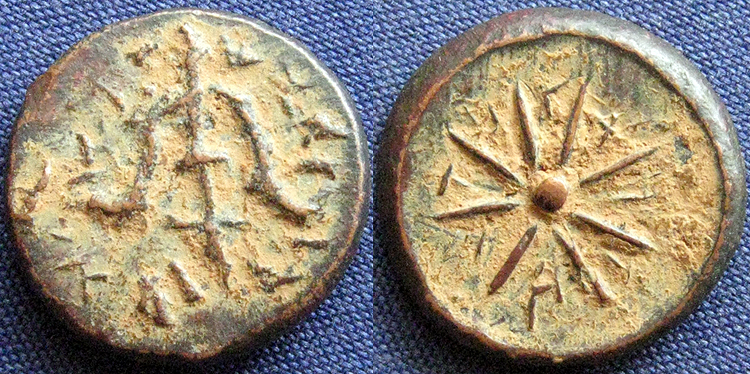
Judaea or Samaria, Anonymous Imitative Issue, AE Prutah, c.6 AD
(Unintelligible legend)
Anchor styled into a pedestal surmounted by crude staurogram
(Unintelligible legend)
Eight-rayed star, letters between rays
15mm x 16mm, 3.48g
cf. Hendin 1193 for obverse and Hendin 1150 for reverse
Ex Midwest "Coins of Christianity"
Collection
Consignor notes and comments:
This coin imitates the famous "widow's mite" minted during the
reign of Alexander Jannaeus (103-76 BC), but employs an anchor style that
was not used until 6 AD under Herod Archelaus (4 BC-6 AD). I speculate
this coin was minted by some Samaritans trying to get a symbol of their
"Messiah" into the Jerusalem population.
|
 |
Judaean Kingdom, Valerius Gratus as Procurator (15-26), Reign of Tiberius, AE Prutah,
Year 11 (23/24 AD)
TIB / KAI / CAP
Legend in three lines within wreath, X at base
IOV | ΛIA
Vertical palm branch, L | IA across fields
16mm, 1.85g
Hendin 1340
Ex Midwest "Coins of Christianity"
Collection
|
 |
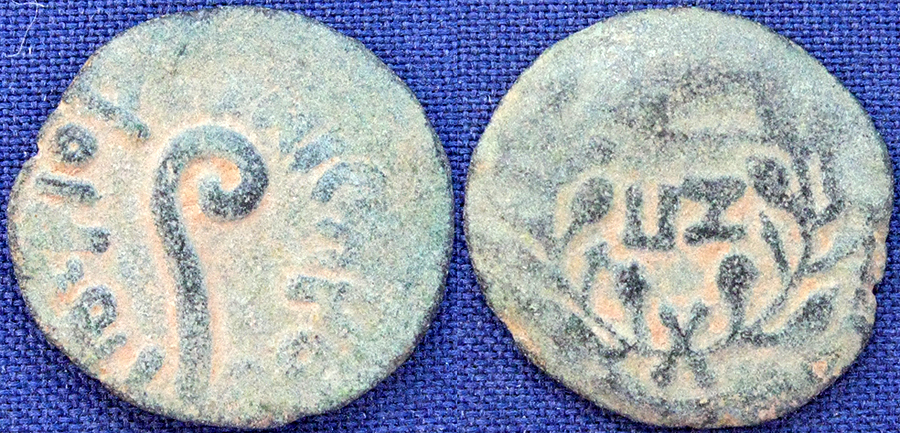
Judaean Kingdom, Pontius Pilate as Procurator (26-36), Reign of Tiberius, AE Prutah,
Year 17 (29/30 AD)
TIBEPIOY KAICAPOC
Legend surrounding lituus
L IZ
Regnal year surrounded by wreath, X at base
14mm x 15mm, 1.38g
Hendin 1342
Ex Midwest "Coins of Christianity"
Collection
Consignor notes: This is an important coin in that it was minted
during Jesus's ministry on earth and just a couple of years before His
crucifixion. The wreath symbolizes victory and the Messiah cross being on
the perimeter suggests that Jesus hadn't reached Divinity yet. Pilate was
best known for his part in Jesus's trial and conviction.
|
 |
Judaean Kingdom, Antoninus Felix as Procurator (52-59), Reign of Claudius, AE Prutah,
Year 14 (54 AD)
TI KΛAYΔIOC KAICAP ΓEPM .
Legend surrounding two crossed palms, L IΔ below
IOV / ΛIA AΓ / PIΠΠI / NA
Legend in four lines within laurel wreath
16mm, 1.85g
Hendin 1347
Ex Midwest "Coins of Christianity"
Collection
|
 |
Judaean Kingdom, Antoninus Felix as Procurator (52-59), Reign of Claudius, AE
Prutah,
Year 14 (54 AD)
TI KΛAYΔIOC KAICAP ΓEPM .
Legend surrounding two crossed palms, L IΔ below
IOV / ΛIA AΓ / PIΠΠI / NA
Legend in four lines within laurel wreath, X at base
15mm x 17mm, 3.07g
Hendin 1347
Ex Midwest "Coins of Christianity"
Collection
Consignor notes: The reverse design with the cross at base shows that
the Jewish leaders rejected Jesus and were sill waiting on
"their" Messiah. Antoninus Felix is best known for his numerous
meetings with the Apostle Paul during Paul's wait for trial in Caesarea.
The entire story of Paul and Felix can be found in Acts 24. There is no
doubt that Paul discussed Christ's life with Felix. Felix had to be aware
of Jesus's "triumphal" entry into Jerusalem with the palm
branches being laid before the donkey.
|
 |
Judaean Kingdom, Antoninus Felix as Procurator (52-59), Reign of Claudius,
Nero and Brittanicus, AE Prutah,
Year 14 (55 AD), Caesarea Mint
NEPω KΛAV KAICAP
Cross shields, two spears behind
BPIT
Palm tree with clusters of dates, L | IΔ / K | AI across fields
16mm x 17mm, 2.31g
Hendin 1348
Ex Midwest "Coins of Christianity"
Collection
|
 |
Judaean Kingdom, Porcius Festus as Procurator (59-62), Reign of Nero, AE Prutah,
Year 5 (59 AD), Jerusalem Mint
NEP / ωNO / E
Legend in wreath
L C • KAIC_APOC
Legend around vertical palm branch
16mm x 17mm, 2.91g
Hendin 1351
Ex Midwest "Coins of Christianity"
Collection
|
 |
Judaean Kingdom,
Bar Kochba Revolt (132-135), AR Tetradrachm (Sela), Year 2 (133/134)
YRUShLM (Hebrew legend = Jerusalem)
Tetrastyle façade of the Temple of Jerusalem, Ark of the Covenant visible
within, Jewish Messianic cross above
Sh B LHR YSRAL (Hebrew legend - Year Two of the freedom of Israel)
Lulav, ethrog to left
25mm x 26mm, 12.07g
Mildenberg 10.1; AJC II, p.266, 12a; Hendin 687; Bromberg II, 395; TJC 230
Ex Midwest "Coins of Christianity" Collection
Consignor notes: A Jewish revolt was led by Simon bar Kochba in 132. The
name "Bar Kochba" means "son of a star". He believed
he was the messiah and successfully held off the Romans for about four
years. His goal was to rebuild the temple and restore the Ark to its
rightful place. The lulav and ethrog (palm branch and citron) were used on
the Feast of Tabernacles.
|
Sunga
Empire - c.187 BC-78 BC |
 |
Sunga Empire, AE 1/2 Karshapana, c.187 BC-78 BC
(No legend)
Elephant standing left facing tree, swastika above
(No legend)
Mountain, anchor, altar and voided cross
12mm x 14mm, 1.80g (across the flats)
Mitchener ACW 4378
Ex Midwest "Coins of Christianity" Collection
Consignor notes: The Sunga Empire was established after the fall of the Maurya
Empire, and existed over parts of modern day India, Bangladesh and Nepal.
|
 |
Sunga Empire, AE Karshapana, c.187 BC-78 BC, Taxila Mint
(No legend)
Tamgha, mountain, swastika and uncertain symbol
(No legend)
Mountain, crest, voided cross and monogram
23mm x 24mm, 13.04g
Mitchener ACW 4416-4417
Ex Midwest "Coins of Christianity" Collection
Consignor notes: Ancient India was diverse in its religions and it appears this
coin displays symbols of the various groups in the area at that time -
Hindus, Brahmans, Buddhists, Jainisms and Judeans.
Just after the Judean removal to Babylon, around 730 BC, the Manasseh
Tribe migrated to India. This tribe made headlines in November 2009 by
returning to Israel for the first time in 2800 years.
The "outlined" Cross eventually became known as the
"Voided Cross" used by Portugal and India throughout history. It
was probably developed to distinguish itself from the swastika, which the
Buddhists used to represent life, strength and good luck. In this use, the
cross represented the coming Messiah.
|
 |
Sunga Empire, AE 1/8 Karshapana, c.187 BC-78 BC, Taxila Mint
(No legend)
Voided cross
(No legend)
Bodhi tree
11mm x 12mm, 1.36g
Mitchener ?
Ex Midwest "Coins of Christianity" Collection
Consignor notes: This specimen is a fractional denomination of the karshapana,
which displays numerous religious symbols. Examples of this denomination
can be found with each of the symbols singularly.
In the ancient Hebrew alphabet, the letter "tav" (X or +) meant
covenant or symbol. The outline was used to distinguish this cross from
the swastika used by the Buddhists to symbolize life.
The Bodhi tree has been part of Buddhist worship for millennia. Its' most
likely meaning being "liberation" or "awakening".
|
|
Kushan |
 |
Afghanistan or "Western Barbarians", Imitative type of Kushan
Kingdom, Kujula Kadphises, AE Tetradrachm, 30-80
Corrupt Greek legend
Diademed, draped bust right
Karosthi legend
Hercules standing facing, right hand resting on club, lion-skin in left, cross
in upper left field
21mm x 22mm, 4.83g
Senior ISCH B6 type
Ex Midwest "Coins of Christianity" Collection
|
 |
Kushan Kingdom,
Vima Takto or "Soter Megas", AE Tetradrachm, c.80-100 AD, Kushan
Kingdom, Taxila
(No legend)
Diademed, draped bust right, seven rays radiant from top of head,
scepter in left hand, three-pronged tamgha behind
BACIΛEIC BACIΛEWN ETP
King on horse walking right, Nike in right hand
Three-pronged tamgha symbol in right field
20mm x 21mm, 8.28g
Senior ISCH B17 type
Ex Midwest Coins of Christianity Collection
|
 |
Kushan Kingdom, Vima Takto or "Soter Megas", AE Tetradrachm, c.80-100 AD,
Taxila
(No legend)
Diademed, draped bust right, eight rays radiant from top of head, scepter in left hand, three-pronged tamgha behind
BACIΛEIC BACIΛEWN ETP
King on horse walking right, Nike in right hand
Three-pronged tamgha symbol in right field
19mm x 20mm, 8.32g
Senior ISCH B17 type
Ex Midwest "Coins of Christianity" Collection
|
|
Kingdom of Persis |
 |
Kingdom of Persis, Oxathres (Vashir) II, AR Hemidrachm, c.Late 1st Century
BC
(No legend)
Diademed bust of bearded king left, monogram behind
( Aramaic legend)
King standing right, holding scepter, facing lit altar
13mm x 14mm, 1.87g
Alram 583
Ex Midwest "Coins of Christianity" Collection
|
|
Celtic Tribes |
 |
Celtic-Carnutes in northwest Gaul, AE16, c.50 BC
(No legend)
Celtic head in "crown"
(No legend)
Bird walking right, smaller bird in front, star behind, serpent above,
Messianic
cross between
15mm x 16mm, 2.72g
BMC 128; de la Tour 6088; SLM 258; Delestrée-Tache II, 2582
Ex Midwest "Coins of Christianity" Collection
|
 |
Celtic-Carnutes in northwest Gaul, AE18, c.50 BC
(No legend)
Unknown man with flowing hair left (sometimes referred to as "Wild
Warrior")
(No legend)
Crescent moon with star at top, wavy line in center separating three
crosses with one above and two below, horizontal line near bottom
connected to series of vertical lines
18mm x 19mm, 2.19g
de la Tour ?
Ex Midwest "Coins of Christianity" Collection
Consignor notes: There is evidence to support some of the lost tribes of
Israel settled in the Gaul region and continued to observe Jewish customs.
My interpretation of the reverse of this specimen is the crescent moon and
star = Star of Jacob; wavy line = separation of Heaven and Earth; upper
cross = God; two lower crosses = Two Messiahs; bottom horizontal and
vertical lines = Earth.
|
|
Roman Imperatorial |
 |
Roman Imperatorial,
Julius Caesar, AR Denarius, 49-48 BC, Military Mint Traveling with Caesar
CAESAR
Elephant standing right, trampling Gallic war trumpet (carnyx)
(No legend)
Culullus, aspergillum, securis surmounted by a dog or wolf head, apex,
Cross graffiti in field
18mm x 19mm, 3.17g
Crawford 443/1;
Caesar 49; Sydenham 1006
Ex Midwest "Coins of Christianity" Collection
|
|
Roman Imperial |
 |
Severus Alexander, AR Denarius, 228-231, Rome
IMP SEV ALE_XAND AVG
Laureate head right, drapery on left shoulder
ANNO_NA AVG
Annona standing facing, head left, grain ears in right hand over filled modius at feet,
anchor in left
18mm x 19mm, 3.11g
RIC IV, Part II, 188 (C)
Ex Midwest "Coins of Christianity" Collection
|
 |
Salonina, Antoninianus, 260-268, Sole Reign, Mediolanum, Officina 2
SALONINA AVG
Draped bust right on crescent, hair weaved in rows with long plait carried
up the back of head and tucked under stephane
AVG IN PACE
Salonina seated left, olive branch in right hand pointing downward,
transverse scepter in left
S in exergue
18mm x 21mm, 3.27g
RIC V, Part I, 58 (C); Göbl 1305r
Ex Midwest "Coins of Christianity" Collection
|
 |
Roman Imperial, Quintillus, AE Antoninianus, 270, Rome
IMP C M AVR CL QVINTILLVS AVG
Radiate, cuirassed bust right
MAR_TI P_A_CIF
Mars advancing left, olive branch in upward in right hand, spear in left, X in
left field
18mm x 20mm, 3.80g
RIC V, Part I, 24 (C)
Ex Midwest "Coins of Christianity" Collection
|
 |
Tetricus I era, Antoninianus, 273-274, "Barbarous Imitation"
IMP TET...
Radiate, cuirassed bust right
SALVS AVG
Salus standing facing, head left, sacrificing over lit altar at left
14mm x 16mm, 2.48g
Imitating RIC V, Part II, 127
Ex Midwest "Coins of Christianity" Collection
|
 |
Tetricus I era, Antoninianus, 273-274, "Barbarous Imitation"
IMP TETRICVS III
Radiate, cuirassed bust right
(No legend)
Spes, nude, standing facing, flower upward in right hand, exaggerated left
hand downward, captive at right, cross in right field
16mm x 17mm, 2.27g
Possibly Imitating RIC V, Part II, 136
Ex Midwest "Coins of Christianity" Collection
|
 |
Probus, Antoninianus, 277, Second Emission, Siscia, Officina 6
IMP C M AVR PROBVS P F AVG
Radiate, helmeted, cuirassed bust left, spear in right hand over shoulder,
shield with pellet design in left
CONCORD-MILIT
Emperor standing right, clasping hand of Concordia standing left
S in lower middle field
++I in exergue (sloppy engraving of XXI)
21mm x 22mm, 2.83g
RIC V, Part II, 650 (C)
Ex Midwest "Coins of Christianity" Collection
Note: This was purchased for the collection as an "imitative"
type because the seller believed the exergual mark of ++I was indicative
of crosses. In reality, this is sometimes a sloppily engraved issue which
includes known examples with retrograde officina marks and the exergue on
this example is just a regular XXI.
|
 |
Constantine I, AE3, 316, Ticinum, Officina 2
IMP CONSTANTINVS P F AVG
Laureate, cuirassed bust right
SOLI INVI_C_TO COMITI
Sol, radiate, standing left, chlamys over left shoulder, right hand raised, globe
outward in left
+ | * across fields
ST in exergue
19mm x 20mm, 2.97g
RIC VII, 45 (S)
Ex Midwest "Coins of Christianity" Collection
|
 |
Constantine I, AE3, 316, Ticinum, Officina 3
IMP CONSTANTINVS P F AVG
Laureate, cuirassed bust right
SOLI INVI_C_TO COMITI
Sol, radiate, standing left, chlamys over left shoulder, right hand raised, globe
outward in left
+ | * across fields
TT in exergue
18mm x 20mm, 2.82g
RIC VII, 45 (C1)
Ex Midwest "Coins of Christianity" Collection
|
 |
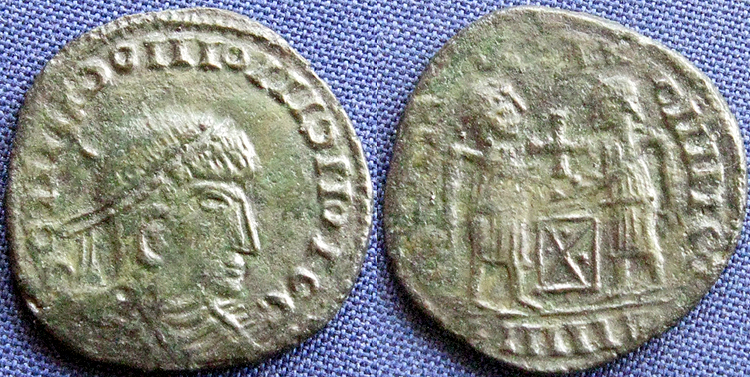
Constantine I, AE3, 318-319, Ticinum, Officina 1
IMP CONSTANT_INVS AVG
High-crested helmet, three pellets on crossbar, * in each field on bowl,
cuirassed bust left, spear over right shoulder, mappa in left hand
VICTORIAE LAETAE PRINC PERP
Two Victories, standing facing each other, inscribing shield with VOT | PR
set on altar with garland
P T in exergue
18mm x 19mm, 2.80g
RIC VII, 83 (R2)
Ex Midwest "Coins of Christianity" Collection
|
 |
Constantine I, AE3, 318-319, Ticinum, Officina 3
IMP CONSTAN_TINVS MAX AVG
Laureate, helmeted, cuirassed bust right
VICTORIAE LAETAE PRINC PERP
Two Victories standing facing each other, inscribing shield with VOT | PR set on altar with garland and *
T T in exergue
16mm x
18mm, 2.93g
RIC VII, 87 (R3)
Ex Midwest "Coins of Christianity" Collection
|
 |
Constantine I, AE3, 319, Siscia, Officina 1
IMP CONSTAN_TINVS AVG
High-crested helmet, two vertical pellets on crossbar, + on each field on
bowl, cuirassed bust left, spear in right hand over shoulder, shield with
outer band with pellets, shield design of rings of pellets
VICTORIAE LAETAE PRINC PERP
Two Victories, standing facing each other, inscribing shield with VOT | PR
above altar with bands on top and bottom with center pellet (altar type J)
ASIS . in exergue
19mm x 22mm, 3.16g
RIC VII, 61 (R3)
Ex Midwest "Coins of Christianity" Collection
|
 |
Constantine II, AE3, 319-320, Ticinum, Officina 1
CONSTANTINVS IVN NOB C
Laureate, cuirassed bust right, Victory on globe in right hand, mappa in
left
VIRTVS-EXERCIT
Labarum inscribed VOT / XX, captive seated on ground on either side
Christogram in left field
P T in exergue
19mm x 20mm, 3.03g
RIC VII, 121 (R3)
Ex Midwest "Coins of Christianity" Collection
|
 |
Licinius I, AE3, 319-320, Ticinum, Officina 1
IMP LI_CINIVS AVG
Helmeted, cuirassed bust right
VIRTVS-EXERCIT
Labarum inscribed VOT / XX, captive seated on ground on either side
Christogram in left field
P * T in exergue
18mm x 19mm, 3.11g
RIC VII, -- (cf. RIC VII, 126 for same of Licinius II)
Ex Midwest "Coins of Christianity" Collection
|
 |
Anonymous Issue during the reign of Constantine I, AE4, 334, Arles,
Officina 2
VRBS-ROMA
Helmet with plume, bust of Roma left in imperial mantle
(No legend)
She-wolf standing left, suckling twins
* Christogram * above
SCONST in exergue
15mm x 16mm, 1.52g
RIC VII, 385 (R3)
Ex Midwest "Coins of Christianity" Collection
|
 |
Constantine I, AE3, 334- September 335, Aquileia, Officina 1
CONSTANTI_NVS MAX AVG
Rosette-diademed, draped, cuirassed bust right
GLOR_IA EXERC_ITVS
Two soldiers standing facing one another, each holding reversed spear in
outer hand and resting inner hand on shield set on ground, two standards
between them
Latin Cross in middle field
AQP in exergue
17mm, 2.65g
RIC VII, 124 (R4)
Ex Midwest "Coins of Christianity" Collection
|
 |
Roman Imperial, Constantine I, AE3, 334- September 335, Aquileia, Officina
1
CONSTANTI_NVS MAX AVG
Rosette-diademed, draped, cuirassed bust right
GLOR_IA EXERC_ITVS
Two soldiers standing facing one another, each holding reversed spear in
outer hand and resting inner hand on shield set on ground, two standards
between them
Latin Cross in middle field
AQP in exergue
16mm x 18mm, 1.94g
RIC VII, 124 (R4)
Ex Midwest "Coins of Christianity" Collection
|
 |
Constantine II, AE3, 334-September 335, Aquileia, Officina 2
CONSTANTINVS IVN NOB C
Laureate, cuirassed bust right
GLOR_IA EXERC_ITVS
Two soldiers standing facing one another, each holding reversed spear in
outer hand and resting inner hand on shield set on ground, two standards
between them
Latin Cross in middle field
AQS in exergue
16mm x 18mm, 2.14g
RIC VII, 125 (R4)
Ex Midwest "Coins of Christianity" Collection
|
 |
Constantine II, AE3, 334-September 335, Aquileia, Officina ?
CONSTANTINVS IVN NOB C
Laureate, cuirassed bust right
GLOR_IA EXERC_ITVS
Two soldiers standing facing one another, each holding reversed spear in
outer hand and resting inner hand on shield set on ground, two standards
between them
Latin Cross in middle field
AQ? in exergue
17mm x 18mm, 3.35g
RIC VII, 125 (R4)
Ex Midwest "Coins of Christianity" Collection
|
 |
Constantine II, AE3, 336, Arles, Officina ?
CONSTANTI_NVS IVN N C
Laureate, cuirassed bust right
GLOR_IA EXERC_ITVS
Two soldiers standing facing, helmeted head looking at each other,
reversed spear in outer hand, inner hand resting on shield, standard with
Christogram on banner between them
?CONST in exergue
15mm x 17mm, 1.25g
RIC VII, 395
Ex Midwest "Coins of Christianity" Collection
|
 |
Constantine I, AE3, 337, Siscia, Officina 5
CONSTANTI_NVS MAX AVG
Rosette-diademed, draped, cuirassed bust right
GLOR_IA EXERC_ITVS
Two soldiers standing facing, helmeted head looking at each other,
reversed spear in outer hand, inner hand resting on shield, standard with
Christogram on banner between them
ESIS* in exergue
16mm, 1.63g
RIC VII, 261 (R3)
Ex Midwest "Coins of Christianity" Collection
|
 |
Divus Constantine I, AE4, 337-340, Antioch, Officina 6
DV CONSTANTI_NVS PT AVGG
Veiled head right
(No legend)
Constantine I, veiled, robed, standing in quadriga right, Hand of God
above welcoming him into Heaven
* in upper field
SMANS in exergue
14mm x 15mm, 1.81g
RIC VIII, 37 (C3)
Ex Midwest "Coins of Christianity" Collection
|
 |
Constantius II as Augustus, AE4, Before April 340, Lugdunum
CONSTANTIVS AVG
Laurel and rosette-diademed, cuirassed bust right
GLOR_IA EXERC_ITVS
Two soldiers standing facing each other, spear in outer hand, inner hand resting on shield, one standard between them with
Christogram on banner
[PLG] in exergue (off-flan)
14mm x 15mm, 1.83g
RIC VIII, 8 var. (horizontal bars vs. X in symbol on banner)
Ex Midwest "Coins of Christianity" Collection
Note: This coin comes from an interesting period where the Lugdunum
(Lyons) mint was using a variety of Christian symbols on the bronze
issues. The careful and fine style of execution of all of the elements on
this specimen should be enough evidence to preclude the execution of the
symbol on the banner being intentional. The expected symbol is a Chi-Rho
(XP
/ Christogram), instead of the two horizontal bars. The other bronze
issues during this period have a reverse legend of AETERNA PIETAS and
issued for Divus Constantine I. The symbols in the field on these issues
are both staurograms (Tau-Rho or TP), however, one of them has a
horizontal crossbar and the other a slanted crossbar, similar to the
Russian Orthodox cross. Certainly a series
well worth further research and documentation, since they were obviously
minted in the years just after the death of Constantine I and his
conversion to Christianity on his deathbed. There may be other Christian
symbols on these series which could be analyzed and documented.
|
 |
Roman Imperial,
Helena, AE4, Before April 340, Trier, Officina 1
FL IVL HE_LENAE AVG
Diademed bust right, wearing imperial mantle and pearl necklace
PA_X PV_BLICA
Pax standing facing, head left, branch in right hand pointing downward, transverse
scepter in left, Latin cross in left field
TRP in exergue
14mm x 15mm, 1.08g
RIC VIII, 42 (S)
Ex Midwest "Coins of Christianity" Collection
|
 |
Theodora, AE4, Before April 340, Trier, Uncertain Officina
FL MAX THEO_DORAE AVG
Diademed bust right, wearing imperial mantle and pearl necklace
PIETAS-ROMANA
Pietas standing facing, head right, carrying infant at her breast
Cross in left field
TR(?) in exergue
14mm, 1.41g
RIC VIII, 43 (S)
Ex Midwest "Coins of Christianity" Collection
|
 |
Constantius II, AE Centenionalis, 348-350, Second Group, Antioch, Officina 1
D N CONSTAN_TIVS P F AVG
Pearl-diademed, draped, cuirassed bust left, globe in right hand
FEL TEMP-REPARATIO
Emperor in military dress standing left, standard in right hand with staurogram
on banner, left hand resting on shield, two bound captives before
ANA in exergue
19mm x 21mm, 3.59g
RIC VIII, 125 (C)
Ex Midwest "Coins of Christianity" Collection
Note: RIC only describes this series as 'emperor holding standard with
various ornaments on banner', so there may very well be numerous different
Christian symbols which have yet to be identified and documented.
|
 |
Constans, AE Half Centenionalis, 348-350, Second Group, First Series, Thessalonica, Officina
2
D N CONSTA_NS P F AVG
Pearl-diademed, draped, cuirassed bust right
FEL TEMP-REPARATIO
Emperor in military dress standing facing, head left, phoenix on globe in right hand,
labarum inscribed with Christogram on banner in left hand,
all within galley piloted by Victory
TESB in exergue
18mm x 20mm, 2.78g
RIC VIII, 120 (C)
Ex Midwest "Coins of Christianity" Collection
|
 |
Magnentius, AE Centenionalis, 351-352, Ambianum (Amiens)
D N MAGNEN_TIVS P F AVG
Bare head, draped, cuirassed bust right, A in left field
VICTORIAE DD NN AVGG ET CAE
Two Victories facing each other, holding shield inscribed
VOT / V / MVLT / X, and surmounted by a staurogram (Tau-Rho)
AMB crescent in exergue
20mm x 22mm, 3.03g
RIC VIII, 23 (S)
Ex Midwest "Coins of Christianity" Collection
Note: According to RIC, the Ambianum mint was established by Magnentius in
mid-350 and was the only mint to use a staurogram, instead of a
Christogram (Chi-Rho) like all of the other mints, for this bronze issue.
The mint was closed at the end of 353.
|
 |
Valens, AV Solidus, February 25, 364-August 24, 367, First Period, Antioch,
Officina 3
D N VALENS- PER F AVG
Pearl-diademed, draped, cuirassed bust right
RESTITVTOR-REIPVBLICAE
Emperor standing facing in military dress, head right, Victory on globe in
left hand, labarum in right with cross on banner
Staurogram in left field
ANΓ in exergue
21mm, 4.45g
RIC IX, 2(d)viii (Unattested officina)
Ex Midwest "Coins of Christianity" Collection
Note: RIC 2(d) is only attested for officinas B and E for pearl-diademed
bust and officina S for rosette-diademed.
|
 |
Arcadius, AE2, August 9, 378-August 25, 383, Fourth Period, Nicomedia,
Officina 4
D N ARCAD_IVS P F AVG
Pearl-diademed, draped, cuirassed bust right, spear pointing forward in
right hand, shield in left, Hand of God crowning from above
GLORIA RO_MANORVM
Emperor standing facing, head left, labarum inscribed with Christogram in
right hand, left hand resting on shield, bound captive on ground to left
and looking right
Pellet in right field
SMNΔ in exergue
21mm x 24mm, 3.47g
RIC IX, -- (cf. RIC IX, 26 for type)
Ex Midwest "Coins of Christianity" Collection
Note: Apparently an unrecorded series with pellet in field for reverse
type.
|
 |
Valentinian II, AE2, August 25, 383-August 28, 388, Fifth Period, Antioch,
Officina 2
D N VALENTINIANVS P F AVG
Rosette-diademed, helmeted, draped, cuirassed bust right, shield in left
hand, spear pointing forward in right hand
GLORIA RO_MANORVM
Emperor standing facing, head right, right hand raised, globe in left, in
galley sailing left piloted by standing Victory
T | + across fields
ANTB in exergue
22mm x 23mm, 3.97g
RIC IX, -- (cf. RIC IX, 59(b)3 for same without cross in field)
Ex Midwest "Coins of Christianity" Collection
|
 |
Valentinian II, AE2, August 25, 383-August 28, 388, Fifth Period, Constantinople, Officina
2
D N VALENTINI_ANVS P F AVG
Pearl-diademed, draped, cuirassed bust right
VIRTVS E_XERCITI
Emperor standing right, standard with X banner in right hand, globe in left,
left foot on bound captive kneeling on ground to right and looking back
Staurogram in left field
CONSB in exergue
23mm, 5.67g
RIC IX, 83(a)2 (S)
Ex Midwest "Coins of Christianity" Collection
|
 |
Arcadius, AE2, August 25, 383-August 28, 388, Fifth Period,
Constantinople, Officina 3
D N ARCADIVS P F AVGVSIVS
Pearl-diademed, draped, cuirassed bust right
VIRTVS E_XERCITI
Emperor standing right, labarum inscribed with * in right hand, globe in
left, left foot on bound captive kneeling on ground to right and looking
back
Cross in left field
CONSΓ in exergue
22mm x 24mm, 5.21g
RIC IX, 83(c)1 (C)
Ex Midwest "Coins of Christianity" Collection
Note: The obverse legend has the unusual AVGVSIVS instead of AVGVSTVS.
|
 |
Theodosius I, AE2, August 25, 383-August 28, 388, Fifth Period,
Constantinople, Officina 1
D N THEODO_SIVS P F AVG
Pearl-diademed, draped, cuirassed bust right
VIRTVS E_XERCITI
Emperor standing right, labarum with X banner in right hand, globe in
left, left foot on bound captive kneeling on ground to right and looking
back
Cross in left field
CONSA in exergue
23mm x 24mm, 5.26g
RIC IX, 83(b)1 (C)
Ex Midwest "Coins of Christianity" Collection
|
 |
Arcadius, AE2, August 25, 383-August 28, 388, Fifth Period, Constantinople, Officina
4
D N ARCADIVS P F AVGVSIVS
Pearl-diademed, cuirassed, draped bust right
VIRTVS E_XERCITI
Emperor standing facing, head right, standard with * on banner in right
hand, globe in left,
left foot on captive
Staurogram in left field
CONSΔ in exergue
21mm x 22mm, 5.33g
RIC IX, -- (cf. RIC 83(c)2 for same from officina 3)
Ex Midwest "Coins of Christianity" Collection
|
 |
Valentinian II, AE4, August 28, 388- May 15, 392, Sixth Period, Cyzicus, Officina
4
D N VALENTINIANVS P F AVG
Pearl-diademed, draped, cuirassed bust right
SALVS REI_PVBLICAE
Victory advancing left, head right, trophy in right hand over shoulder,
dragging captive with left
Staurogram in left field
SMKΔ in exergue
13mm x 14mm, 1.06g
RIC IX, 26(a)4 (C)
Ex Midwest "Coins of Christianity" Collection
|
 |
Honorius, AE3, c.400, Uncertain mint
D N HONORI_VS P F AVG
Pearl-diademed, draped, cuirassed bust right
(No legend)
Reverse defaced and reengraved with cross and hashes
16mm x 17mm, 2.11g
Ex Midwest "Coins of Christianity" Collection
|
 |
Theodosius II, AE3, 401-403, Antioch, Officina 3
D N THEODOSIVS P F AVG
Pearl-diademed, helmeted, cuirassed bust facing, shield with cross design
in left hand, spear in right hand over shoulder
CONCORDI_A AVGG
Concordia enthroned facing, vertical scepter in right hand, Victory on
globe in left hand, right foot on prow
ANTΓ in exergue
14mm x 15mm, 2.57g
RIC X, 100 (S) (Arcadius)
Ex Midwest "Coins of Christianity" Collection
|
 |
Aelia Eudoxia, AE3, 400-404, Antioch, Officina 3
AEL EVDO_XIA AVG
Pearl-diademed, draped bust right, wearing pearl necklace and earrings,
hair elaborately weaved with long plait up the back of head and tucked
under diadem, hand of God holding wreath above head
SALVS REI_PVBLICAE
Victory seated right on cuirass, inscribing Christogram on shield set on a
column
ANTΓ in exergue
16mm x 17mm, 2.12g
RIC X, 104 (S) (Arcadius)
Ex Midwest "Coins of Christianity" Collection
|
|
Roman Provincial |
 |
Roman Provincial, Arabia Petraea-Philadelphia, Elagabalus, AE14, 218-222
AVT E CAR ANTWNINOC
Laureate head right
ΦILKO-ICVP
Draped, veiled bust of Astaria right, four-pointed star above head
14mm x 15mm, 2.99g
SNG ANS 1399-1401; BMC Arabia 21
Ex Midwest "Coins of Christianity" Collection
Consignor notes: Astaria was the goddess of reading of the stars and the
oracle of the night. Philadelphia was one of the cities in the Decopolis,
and was located east of Jerusalem, but part of Syria. It was one of the
churches mentioned in the book of Revelation 3:11.
|
 |
Roman Provincial, Judaea-Ascalon, Pseudo-Autonomous Issue under Titus, AE14, Year
176 (72/73 AD)
(No legend)
Draped, turreted, veiled bust of Tyche right
ςΘP / AΣ
War galley right, cross on prow
14mm x 15mm, 4.07g
cf. SNG Copenhagen 29; RPC 2204
Ex Midwest "Coins of Christianity" Collection
Consignor notes: Ascalon was founded thousands of years ago and continues
to be an important port city in modern day Israel. It was the birthplace
of Herod, who built many ornate buildings before the birth of Jesus.
Greeks frequently placed objects on the prow of their galleys to honor the
god who protected their journey. Clearly, there was a group of Christians
for this issue who wanted to invoke the protection of Christ on their
voyage.
|
 |
Roman Provincial, Lydia-Thyatira, Nero (54-68), AE20, c.62-65
NEPΩN KΛAYΔIOC KAICAP CEBACTOC
Laureate head of Nero right, staurogram countermark on portrait
ΠOΠΠAIAN CEBACTHN ΘYATIPHNOI
Draped bust of Poppaea right
19mm x 20mm, 3.27g
BMC Lydia p. 302, 65; SNG Cop --; SNG von Aulock --
Ex Midwest "Coins of Christianity" Collection
Consignor notes and comments:
Thyatira was located in modern-day western Turkey. It was best known for its dye
and textile industries. The Book of Acts 16 tells of the first European
Christian convert named Lydia, who was a dealer in purple fabric. Thyatira
was also named as one of the Seven Churches in Revelation 2.
The area around Thyatira also had a large population of the Samaritan and
Jewish diaspora. It's obvious from this countermark that a Samarian had
reached a prominent position that allowed him to "qualify" or
"certify" coins. The fact that a staurogram was allowed to be
used as a countermark design is very unusual.
|
 |
Roman Provincial, Moesia Inferior-Markianopolis, Geta, AE16, 209-211
Π CEΠTI-ΓETA C
Bare-headed, draped, cuirassed bust right, seen from behind
MAPKIANOΠOΛITΩN
Legend surrounding crescent and star with planets
16mm x 17mm, 2.75g
Moushmov 519
Ex Midwest "Coins of Christianity" Collection
Consignor notes and comments: The arrangement of the moon, star and
planets on the reverse may possibly show the alignment of those bodies at
the time of Yeshua's birth. This can be compared to the diagram of the
alignment in Dr. Molnar's book (''The Star of Bethlehem: The Legacy of the
Magi'' (Rutgers University Press): http://www.nytimes.com/1999/12/21/science/coin-may-link-star-of-bethlehem-to-king-of-planets.html
Apparently a rather scarce piece and certainly an interesting reverse
variety.
|
 |
Roman Provincial, Moesia Inferior-Markianopolis, Geta, AE16, 209-211
Π CEΠTI-ΓETA C
Bare-headed, draped, cuirassed bust right, seen from behind
MAPKIANOΠOΛITΩN
Legend surrounding crescent and star with planets
16mm x 18mm, 2.33g
Moushmov 519
Ex Midwest "Coins of Christianity" Collection
|
 |
Roman Provincial, Moesia Inferior-Nikopolis ad Istrum, Caracalla, AE16, 198-217
ANTΩNIN_OC AVP KAI
Bare-headed, draped, cuirassed bust right, seen from behind
NIKOΠOΛITΩN ΠPOC ICTPO
Legend surrounding star and crescent
16mm x 18mm, 3.54g
Varbanov 2983
Ex Midwest "Coins of Christianity" Collection
|
 |
Roman Provincial,
Syria: Seleucis and Pieria-Antiochia ad Orontem, Autonomous Issue under
Augustus (27 BC-14 AD), AE Trichalkon, Actian Year 42 (11 AD), Group Two,
Later Coinage under Q. Caecilius Metellus Creticus Silanus
(No legend)
Laureate head of Zeus right
ANTIOXEΩN MHTPOΠOΛEΩΣ
Ram leaping right, looking back, star above,
BM below
19mm x 20mm, 5.13g
Butcher 56; BMC 62
Ex Midwest "Coins of Christianity"
Collection
Consignor notes: Yeshua would have been approaching his 18th birthday when
this coin was minted. The ram not only represented Aries, but also,
according to Zoroastrian beliefs, represented the kingdom of Judaea. The
star stood for a Divine King that had recently been born. Therefore, this
motif represented Yeshua's birth in Judaea. This reverse type was used in
Antioch until around 250 AD.
|
 |
Roman Provincial,
Syria: Seleucis and Pieria-Antiochia ad Orontem, Autonomous Issue under Hadrian
(117-138), AE Quarter Unit (?), Caesarean Year 177 (128/129), Group 2, Officina
2
ANTIOXEWN THC MHTPOΠOΛEWC
Veiled, turreted, draped bust of Tyche right
(No legend)
Ram running right, looking back, star and crescent above
B in left field, ET ZOP below
15mm x 19mm, 3.07g
Butcher 268; Paris 417
Ex Midwest "Coins of Christianity"
Collection
Consignor notes: This reverse type is thought to reference the Star of
Bethlehem.
|
 |
Roman Provincial,
Syria: Seleucis and Pieria-Antiochia ad Orontem, Autonomous Issue under Hadrian
(117-138), AE Quarter Unit (?), Caesarean Year 177 (128/129), Group 2, Officina
3
ANTIOXEWN THC-MHTPOΠOΛEWC
Veiled, turreted, draped bust of Tyche right
(No legend)
Ram running right, looking back, star and crescent above
Γ in left field, ET ZOP below
17mm x 18mm, 4.63g
Butcher 269; Paris 418
Ex Midwest "Coins of Christianity"
Collection
Consignor notes: This reverse type is thought to reference the Star of
Bethlehem.
|
 |
Roman Provincial,
Syria: Seleucis and Pieria-Antiochia ad Orontem, Autonomous Issue under
Antoninus Pius (138-161), AE Quarter Unit (?), Caesarean Year 195 (146/7), Group
5
ANTIOXEWN THC-MHTPOΠOΛEWC
Veiled, turreted, draped bust of Tyche right
(No legend)
Ram running right, looking back, star and crescent above
(Officina off flan or does not exist), ET EPP below (first P reversed)
15mm x 16mm, 2.17g
Butcher 354
Ex Midwest "Coins of Christianity"
Collection
Consignor notes: This reverse type is thought to reference the Star of
Bethlehem.
|
 |
Roman Provincial,
Syria: Seleucis and Pieria-Antiochia ad Orontem, Elagabalus, AE18, 218-222, SC
Issues
AYT K M AY ANTΩNINOC C
Radiate head right
S C
Legend in laurel wreath, terminating in star, ram leaping right below and
looking back, Δ / E across fields
18mm, 3.68g
Butcher 472
Ex Midwest "Coins of Christianity"
Collection
|
 |
Roman Provincial, Thrace-Byzantium, Julia Mamaea, AE27, 222-235
IOVΛIA MA_MAIA AVΓ
Draped bust right, wearing stephane, hair weaved in rows and tucked into
coil at base
EΠ ΦPO_NTΩNOC BVZA_NTIΩN
Dolphin right, belted bonito above and below
26mm x 27mm, 12.00g
Moushmov 3411
Ex Midwest "Coins of Christianity" Collection
|
|
Bosporus Kingdom, Roman Empire Period |

|
Bosporus Kingdom, Roman Empire Period, Thothorses (285/286-308/309), AE Stater, 591 Bosporan Era (294/295 AD)
BACIΛEωC ΘOΘOPCOV
Diademed, draped bust of Thothorses right, + in right field
a9Φ
Laureate, draped bust of emperor right, tamgha #2 in right field
19mm x 20mm, 7.79g
MacDonald 642/4
Ex Midwest "Coins of Christianity" Collection
|
|
Roman Imitative |
 |
Undetermined, AE3, Undetermined Imitative Type of VLPP Series
COIIIIOOIIIOIIIOIIOIOC
Laureate, cuirassed bust right
OOIIIIIOIIIOIIIIIOO
Two Victories standing, facing each other and holding cross on altar with X and pellet pattern
+IIIIIII in exergue
17mm x 18mm, 2.00g
Ex Midwest "Coins of Christianity"
Collection
Consignor notes: Obviously, a Christian engraver placed the cross on this
coin to replace the official plaque pledging the Vows of the People to
Constantine and the Empire.
|
 |
Barbarous Imitation, AE4, c.Early 5th Century
(No legend)
Pearl-diademed, draped, cuirassed bust left
(Partial blundered legend)
Victory advancing right, left hand raised as if holding trophy, dragging
captive with right
Cross in right field
9mm x 10mm, 0.75g
Imitating Valentinian III issues with same but opposite direction obverse
and reverse?
Ex Midwest "Coins of Christianity" Collection
|
|
Axumite Kingdom |
 |
Axumite Kingdom, Anonymous Early Christian Kings, Time of Ezanas (c.340-425),
AE Unit, Ethiopian Mint
(Corrupted legend)
Draped bust right, wearing headcloth
(Ge‘ez legend = "May this please the country")
Legend surrounding cross within circular border
12mm x 13mm, 1.45g
Hahn, Aksumite 33; Munro-Hay type 52; BMC Axum 83-96
Ex Midwest "Coins of Christianity" Collection
Consignor notes: Christianity was introduced to Axum in the early years
after Christ's death (refer to Acts 8:27-40, the story about the Ethiopian
Eunuch being baptized). This is the earliest known Christian coin minted
in a country outside of the Roman Empire.
|
|
Sogdiana Kingdom |
 |
Sogdiana Kingdom, King Rahanch (?), AE18, c.500 AD
(No legend)
Crowned bust of king facing 3/4 left
(No legend)
Tamgha in beaded circle, cross to left, symbol to right
18mm x 20mm, 1.57g
Ex Midwest "Coins of Christianity" Collection
Consignor notes: Sogdiana encompassed parts of modern day Tajikistan,
Afghanistan, China and Iran. The religion of this region was a mix of
Buddhism, Zoroastrianism and "fire veneration". Based on this
coin, it was also influenced by Christianity for some period of time.
Sogdiana was invaded and conquered by Arab Iran in the 700s. Islam became
the predominant religion in the 800s and the Muslim leaders promptly
destroyed all previous temples and places of worship.
|
|
Byzantine |
 |
Anastasius, AE Half Follis (Small Module), 498-518, Post-Reform Copper
Coinage, Constantinople, Officina 5
D N ANASTA _SIVS P P AVG
Pearl-diademed, draped, cuirassed bust right
(No legend)
Large K, cross to left, E to right
18mm, 4.39g
SB 24
Ex Midwest "Coins of Christianity" Collection
|
 |
Justin I, AE Pentanummium, 518-527, Nicomedia
D N IVST_INVS AG
Diademed, draped, cuirassed bust right
(No legend)
Large Christogram, N / . | E across fields, two pellets below
12mm x 14mm, 2.03g
SB 93
Ex Midwest "Coins of Christianity" Collection
|
 |
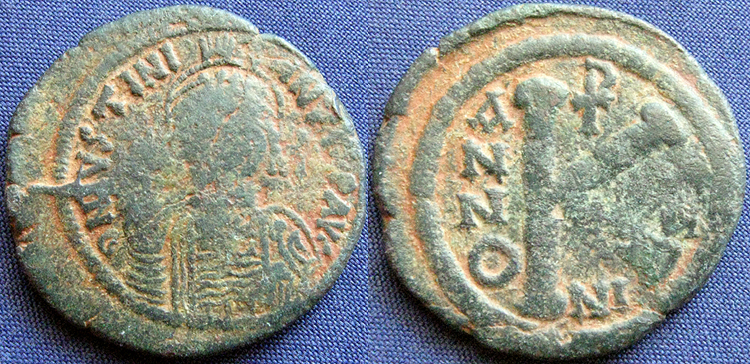
Byzantine Empire, Justinian I (527-565), AE Half Follis, 541/542, Year 17,
Nicomedia
D N IVSTINI_ANVS P AVG
Helmeted, cuirassed bust facing, globus cruciger in right hand, shield in left, cross in right field
Large K, A/N/N/O to left, Xu/II to right, Staurogram above, NI below
28mm x 29mm, 9.56g
SB 203
Ex Midwest "Coins of Christianity" Collection
|
 |
Byzantine Empire,
Maurice Tiberius, Æ Follis, Year 9 (590/591), Constantinople, Officina 2
d N mAV-TIbER P P AVG
Helmeted, cuirassed bust facing, shield in left hand, globus cruciger in right, Staurogram countermark on portrait
Large M, A/N/N/O to left, ςI | II to right, cross above, B below
CON in exergue
29mm x
33mm, 11.28g
SB 494
Ex Midwest "Coins of Christianity" Collection
|
 |
Arab Pseudo-Byzantine, Umayyad Caliphate, AE Fals imitating Constans II,
c.Late 680s-693, Pre-Reform type, Emisa (Hims) Mint
(Uncertain legend)
Figure, beardless, standing facing, wearing crown and chlamys, holding long cross and globus cruciger
Large M, A/N/N/O to left, Staurogram and * above, C / I / C to right, inverted
crescent and Y below
Mint name in Arabic in exergue
21mm x 23mm, 4.02g
Album 103
Ex Midwest "Coins of Christianity" Collection
Consignor notes: The Umayyad Caliphate was the second ruling government
after the death of Muhammad. At this point, the Islamic Empire was limited
to the Saudi Arabian peninsula, but began expanding in 622 AD. Their first
conquests included Syria, Judaea, Turkey and Persia in 661 and ended in
750 with the victory over the North African nations along with Spain and
France. The coins minted in Syria and Judaea imitated the contemporary
Byzantine Empire issues, but included symbols of Christianity and Judaism,
such as crosses, staurograms, Christograms and menorah, to appease the
populace after the conquests.
|
 |
Anonymous (attributed to Nicephorus III), AE Follis, Class I, 1078-1081
IC | XC across fields
Bust of Christ facing, wearing nimbus cruciger, pallium and colobium,
raising right hand in benediction, book of Gospels in left hand, all
inside linear border
(No legend)
Latin cross with X at center, globule and two pellets at each extremity,
floral ornament in either side of lower fields, crescents in either side
of upper fields
23mm x 25mm, 5.12g
SB 1889
Ex Midwest "Coins of Christianity" Collection
|
|
Hindus in Multan and Sindh |
 |
Gujarat Kindom, Sri Parakuta Chach in Sindh and Multan, Alor Dynasty, AR
Drachm, c.632-711, Uncertain mint
(No legend)
Series of dots, Sindha letter "haNDa" and starurogram above
(No legend)
Trisecting lines
15mm x 16mm, 1.22g
Mitchener (?)
Ex Midwest "Coins of Christianity" Collection
Consignor notes: Sindh is a region in modern-day India and Pakistan known as the Indus Valley. It is an ancient Brahman, Buddist and Zoroastrian Kingdom that also had a significant
Jewish and Samaritan population. It was converted to Christianity starting with the Apostle Thomas in 50 AD. This coin is from the last minted before the area was conquered by the
Islamic Umayyad Caliphate and forced into conversion to Islam in 711.
|
|
Crusader States |
 |
Crusader States-Cyprus, Peter I (1359-1369), Gros Grand
+ PIERE PAR LA GRACE D DIE ROI
Legend surrounding single dotted border enclosing king enthroned facing,
sword in right hand, globus cruciger in left, in right field shield
contain Lusignan arms, rampant lion left
+ DE IERUSALEM : 7 DE ChIPRE
Legend surrounding single dotted border enclosing Jerusalem cross with
small cross at center
Plain edge
26mm x 27mm, 4.41g, Silver
Mintage: Unknown
Ex Midwest "Coins of Christianity" Collection
|
|
World Coins |
 |
Austria, 500 Schilling, 2000, 2000th Anniversary of Christianity Series
REPUBLIK ÖSTERREICH
Mary holding baby Jesus, welcomed by three kings
(No legend)
Half-length bust of Christ, nimbate, Gospels upward in right hand, left
hand raised in benediction
Reeded edge
10.1400g, 0.9860 Gold, .3170oz AGW, 22mm
Mintage: est. 50,000
KM 3065
Ex Midwest "Coins of Christianity" Collection
ICG certified graded MS-70
|
 |
Bulgaria, Ivan Alexander and Mikhail Asen, 1355-1371, AR Grosh
IC | XC
Nimbate Christ standing facing, both hands raised, cyrillic symbols in
fields
(No legend)
Ivan and Mikhail standing facing, each holding cross in outer hand, banner
on staff between, monograms across fields
Plain edge
20mm x 22mm, 1.61g, Silver
Mintage: Unknown
Dimnik-Dobrinic, Slavic, 9.1.2, p.223
Ex Midwest "Coins of Christianity" Collection
|
 |
Ceylon, AE Massa, c.11th Century
(No legend)
Octopus man in beaded circle, cross in lower right field
(No legend)
Figure reclining left in beaded circle
17mm, 2.58g
Ex Midwest "Coins of Christianity" Collection
|
 |
French States-Bishopric City of Strasbourg, Heinrich III (1245-1260),
Denier
(No legend)
Crowned, draped bust of bishop right, within single border
(No legend)
Lamb of God standing left, head reverted, long cross across its body,
within single border
Plain edge
15mm, 0.50g, Silver
Mintage: Unknown
Ex Midwest "Coins of Christianity" Collection
|
 |
Germany-City of Hall, Anonymous Issue, Hand Heller, 14th-15th Century
(No legend)
Hand of God, palm facing
(No legend)
Splayed cross, pellet at arms, all within circle
Plain edge
17mm x 18mm, 0.65g, Silver
Mintage: Unknown
Saurma 1365, 608
Ex Midwest "Coins of Christianity" Collection
|
 |
Italian States-Venice, Michele Steno as Doge (1400-1413), Ducat, Venice Mint
. S . M . VENETI-MICHAEL STEN
Doge kneeling left before nimbate St. Mark standing right, both holding pendant flag between them,
D / V / X in center field
REGIS . ISTE . DUCAT-. SIT . T . XPE . DAT : O : TV
Christ, nimbate, standing facing within oval and surrounded by stars, book of Gospels
in left hand, right hand raised in benediction
Plain Edge
20mm x 22mm, 3.26g, Gold
Paolucci 38.1;
Friedburg GCW 1230
Ex Midwest "Coins of Christianity" Collection
|
 |
Malta, Grano, 1709
IN . HOC . SIGNO . MILITAMVS
Maltese cross, 1 | 7 | 0 | 9 in angles, 0 recut
* RECTAM . FACIT . SEMITAM
Lamb of God walking left, head reverted, holding staff and banner
Plain edge
2.02g, 19mm, Copper
Mintage: Unlisted
KM 140
Ex Midwest "Coins of Christianity" Collection
|
 |
Poland, 2 Zlote, 2000, Holy Year Issue
RZECZPOSPOLITA POLSKA
Polish eagle, 20 | 00 across fields, ZL 2 ZL below flanked by row of stars
WIELKI JUBILEUSZ ROKU 2000
Cross with Christogram medallion at center, holy animals and angel in
quadrants
Edge Lettering: * NARODOWY BANK POLSKI
8.12g, 27mm, Brass
Mintage: 1,500,000
KM Y-376
Ex Midwest "Coins of Christianity" Collection
|
 |
Portugese-India, Joao III, Tin Dinheiro, 1521-1557, Lisbon Mint for Melaka
+ IOA : III : POR : ET : AI :
St. George's cross
(No legend)
Astrolabe
Plain edge
20mm x 21mm, 2.27g, Tin
Sim J3.07; J.F.Vaz "Indo-Portuguese Money" J3.04
Ex Midwest "Coins of Christianity" Collection
|
 |
Portugal, 1000 Reis, 1898
CARLOS I REI E AMELIA RAINHA DE PORTUGAL
Jugate busts of Carlos I and Amelia left
* 4 : CENTENARIO DA DESCOBERTA DA INDIA * 1000 REIS / * IN HOC SIGNO
VINCES * 1498 - 1898
Legend surrounding single dotted border enclosing second part of legend
surrounding Jerusalem cross
Reeded edge
25.0000g, 0.9170 Silver, .7368oz ASW, 47mm
Mintage: 300,000
KM 539
Ex Midwest "Coins of Christianity" Collection
|
 |
Spain-Castile and Leon, John I, 1379-1390, Billon Blanca del Agnus Dei,
Toledo Mint
+ CATA . MVNDI . MISERE
Legend surrounding single dotted border enclosing crowned Y, T | O across
fields
+ AGNVS : DEI : QITOLIS : PE
Legend surrounding single dotted border enclosing Lamb of God facing left,
holding banner, T in left field
Plain edge
21mm x 22mm, 1.74g, Silver
Mintage: Unknown
Ex Midwest "Coins of Christianity" Collection
|
 |
Vatican City, Pope Pius XI, 2 Lira, 1936
PIVS . XI . PONT-MAX . AN . XV
Papal arms, 19_36 below
STATO DELLA CIA_TA DEL VATICANO
Shepard standing facing, carrying lamb on his shoulders
L . | 2 across fields
Plain edge
9.81g, 29mm, Nickel
Mintage: 40,000
KM Y-6
Ex Midwest "Coins of Christianity" Collection
|
 |
Vatican City, 1 Scudo, 1965, Sovereign Military Order of
Malta
F ANGELVS DE MOJANA M M H H * 1965 *
Bust facing 3/4 left
+ ECCE . AGNVS . DEI . QVI . TOLLIT . PECCATA . MVNDI
Lamb of God walking left, head reverted, holding staff and banner
1 SCVDO in exergue
Reeded edge
12.04g, .986 Fine, 0.3804 ASW, 33mm, Silver
Mintage: 3,000
Bruce, X-13 (Unusual World Coins, Colin Bruce II)
Ex Midwest "Coins of Christianity" Collection
|
Medals
& Tokens |
 |
Unknown Issuer, Token, Uncertain Period
(No legend)
Lamb of God walking right,
holding long cross with banner
(No legend)
Cross with bar with globules in background
Plain edge
27mm x 29mm, 10.30g, Lead?
Ex Midwest "Coins of Christianity" Collection
|
 |
France, Jeton, c.15th Century
+ ..VEM + F...TA : PI
Legend surrounding single dotted border enclosing Lamb of God facing left,
holding long cross with banner
+ LAT On : SVI nOVOG + D G
Legend surrounding single dotted border enclosing cross fleurée with
bars; pellets in quarters; all within quadrilobe with arches ending in
trefoils
Plain edge
21mm x 23mm, 1.47g, Copper
Ex Midwest "Coins of Christianity" Collection
|
 |
France, Henry IV (1553-1610), Jeton, 1608, Municipality of Orleans
POVR . LA . MAISON . DE . VILLE . D ORLEANS .
Aurelia standing facing, head right, grapes and grains upward in right
hand, left hand resting on shield of Orleans, city view in background, .
AVRELIA . in exergue
. A . DOMINO . FACTVM . EST . ISTVD .
Christ, crucified in center, King Henry, crowned and armored kneeling at
left, Joan of Arc, with sword, kneeling at right
. 1608 . in exergue
Plain edge
27mm, 5.20g, Brass
Mitchiner 3092, p.1029; Feuardent 8108
Ex Midwest "Coins of Christianity" Collection
|
 |
France, Louis XIV (1643-1715), Jeton, 1664
. LVD . XIIII . D . G-FR . ET . NAV . REX .
Laureate, draped bust rght
FOEDERE HELVETICO INSTAVRATO
King standing facing at left, head right, Dauphin behind, the Swiss
representatives standing at right, altar inscribed with IHS at center,
surmounted by cross, radiant dove (Holy Spirit) above
. 1664 . in exergue
Plain edge
27mm, 4.68g, Copper
Mitchiner p.1070; Feuardent 1165
Ex Midwest "Coins of Christianity" Collection
Note: This jeton is for the recreation of the Company of One Hundred Swiss
Guards in 1664, following the renewal of the treaty in that year.
|
 |
France, Louis XIV (1643-1715), Jeton, 1692, Paris Mint
LVDOVICVS . MAGNVS-REX . CHRISTIANESS .
Laureate head right, L R below truncation
QVID . MISCERE . IVVAT . VIRES . 1692 .
Jupiter reclining left on eagle in cloud, wearing billowing cloak,
thunderbolt in right hand, striking down masses with lightning from left
hand
DE . LA . 4 . PRE . DEM / DE FOVRCY . CON / DESTAT . in exergue
Plain edge
27mm, 7.89g, Copper
Mitchiner 3666, p.987
Ex Midwest "Coins of Christianity" Collection
|
 |
Switzerland-Geneva, Medal by A. Bovy, For the Festival of Christmas in
1831
(No legend)
Radiant bust of Christ left, A. BOVY. F. below
AIMEZ-VOUS / LES UNS / LES AUTRES
Legend in three lines
Plain edge
24mm, 6.61g, Bronze
Mintage: 6,000
Société d'histoire et d'archéologie de Genève, No. 238, p.158
Ex Midwest "Coins of Christianity" Collection
|
 |
Russia, Alexander II Nikolaevich (1855-1881), AE Medal, 1866, Moscow Mint
(Legend in cyrillic)
Bare head of Alexander left
(No legend)
Facing head of Christ, nimbate, O | Ω | N in crossbars, drapery in
background, engraver's name below
Plain edge
43mm, 36.19g, Bronze
Mintage: unknown
Ex Midwest "Coins of Christianity" Collection
|
|